Cambridge University center to examine potential threat posed by artificial intelligence

The UK's prestigious University of Cambridge is to play host to a new center where experts will analyze the possible dangers of advanced artificial intelligence. Founded by philosophy professor Huw Price, cosmology professor Martin Rees, and Skype co-founder Jann Tallinn, the university says its Center for the Study of Existential Risk is set to open on campus next year. While acknowledging the far-fetched nature of a HAL 9000-style AI rebellion, Price told the AP that "it seems a reasonable prediction that some time in this or the next century intelligence will escape from the constraints of biology."
[Source: The Verge]

Microsoft 'Xbox TV' device due in 2013 with casual gaming and streaming

Microsoft is building an Xbox set-top box. Multiple sources familiar with Redmond's plans have confirmed to The Verge that the company plans to introduce a low-cost alternative to its Xbox console, designed to provide access to core entertainment services. The move will allow Microsoft to further increase its presence in the living room, providing consumers with a choice between a set-top box or a full next-generation Xbox console.

We're told that the set-top box is part of a two-SKU strategy for Microsoft's next-generation of Xbox hardware that will be unveiled in 2013, with a release date ahead of the holiday shopping season. The device will run on the core components of Windows 8 and support casual gaming titles rather than full Xbox games typically found on a dedicated console. Although hardware specifications aren't fully locked down, we understand Microsoft will use a chipset to enable an "always on" device that boots quickly and resumes to provide near-instant access to TV and entertainment services.

[Source: The Verge]

Internal Apple video documents Apple Store philosophy

Washington Square Films (NYC) gives us a rare look at one of the internal videos that Apple has shown its Store employees. This one is obviously over a year old with Ron Johnson at the helm (the date says 7/7/2011). The video is a pretty impressive piece of work from director Peter Sillen for something that never aired publicly. Among other interesting tidbits, the video shows store mock-up inside Covent Garden (London) space in 2008 before construction with Apple execs examining design elements.

The video seems to be the type you might see on TV and – just guessing here – with the departure of Ron Johnson may have been scrapped without stable store leadership to fill in. Bob Bridger, Apple VP for Retail Development, gets significant ‘face time’ as well.

To watch the video, click here.

[Source: 9to5Mac]

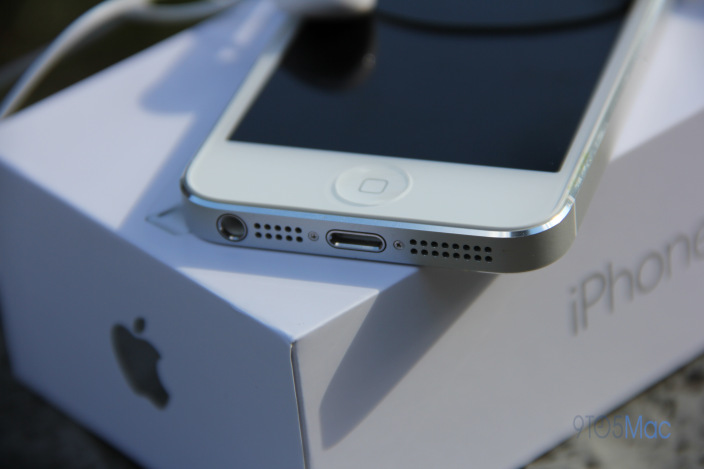
Apple had to acquire Lightning trademark from Motorcycle manufacturer Harley-Davidson

In order to get its new Lightning technology out on the market, Apple had to acquire the trademark “Lightning” from the popular motorcycle maker Harley-Davidson. According to Patently Apple, two trademark applications published on Sunday by the EU Patent & Trademark Office show the transfer of the trademark officially went down on Saturday. The term “Lightning” is still protected until 2013 under the original filing, and Harley-Davidson still owns some rights to the term. Still having access more than likely gives the Motorcycle manufacturer the right to use Lightning on some of its products, which includes helmets and electrical parts, while Apple also has free reign. It seems kind-of odd a term like “Lightning” can be trademarked.

[Source: 9to5Mac]

Beaten, twisted, sprayed and sat on: how Samsung stress tests its phones

Just treated yourself to a new Samsung Galaxy S III or a Note II but wondering how the plastic body will stand up to the rigors of daily life? The manufacturer's showing off a smorgasbord of tests its smartphones go through in the labs while being prepped for prime time. These experiments are engineered to see how sample and prototype devices fare when subjected to use and abuse -- including having their buttons mashed thousands of times, being twisted, splashed with water, and tossed in a churning pot of killer corn to gauge scratch resistance. One test even plonks a fake, denim-clad posterior onto unsuspecting phones, attempting to bend them out of shape. Sammy's hardly going to smash things in its own marketing, but you may still glean some sadistic pleasure from the video after the break -- and understanding Korean is optional.

[Source: Engadget]

Samsung Galaxy Camera reaches Canada on December 7th with carrier-independent 3G

Canadians won't have to race to the border or gamble on an import if they're jonesing for a Samsung Galaxy Camera to call their own. As of December 7th, they'll find the Jelly Bean-touting shooter sitting either in a local Black's Photography store or the official Samsung store in Burnaby, BC. The Canuck model keeps the HSPA+ data we've seen in the AT&T version, but the similarity in networks up north works to a budding photographer's advantage: a data micro-SIM from any of the larger carriers will be enough for some 3G photo sharing. Samsung is oddly silent on just how many toonies it will take to buy the Galaxy Camera, although a near-perfect parity in currency suggests the Canadian price won't be too far from the $500 US sticker.

[Source: Engadget]

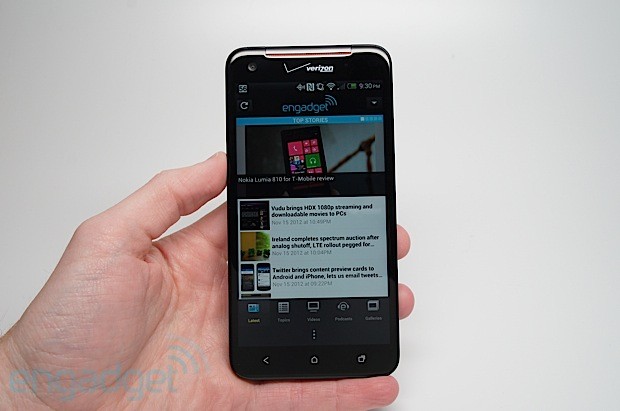
Hack gives HTC Droid DNA the bootloader unlock that Verizon took away

Custom ROM fans were briefly teased with the prospect of Verizon loosening its anti-modding stance when the HTC Droid DNA first arrived: in the pre-release days, the official HTCDev portal allowed unlocking the DNA's bootloader. While the carrier unfortunately clamped down and denied the option by the time the giant smartphone was in stores, that hasn't stopped Android Police and Sean Beaupre from keeping the dream alive through very unofficial means. A special backup file, a carrier ID generator app, a shell script and judicious use of ADB tweak the carrier information to trick HTCDev and let the unlock work once again. To call this a risky procedure would be an understatement, however -- venturing past a certain point raises the real possibility of bricking the device, and HTC's bootloader tool already puts limits on post-unlock support even when it's blessed by carriers. Should the urge to liberate the Droid DNA overwhelm a sense of caution (or a wait for the Deluxe), you'll find both the hack and unofficial help through the source links.

[Source: Engadget]

ComScore: Black Friday online spending rings in at a record $1.04 billion

Considering the parody-worthy dangers of America's busiest shopping day, it's no surprise to hear that online consumerism is on the rise. According to ComScore, 57.3 million Americans took their wallets to digital storefronts on Black Friday, spending a record $1.04 billion in the process. "With Black Friday online sales up 26 percent and surpassing $1 billion for the first time, coupled with early reports indicating that Black Friday sales in retail stores were down 1.8 percent, we can now confidently call it a multi-channel marketing phenomenon," stated ComScore Chairman Gian Fulgoni. The organization also noted that digital content sales are on the rise, too, citing a 29 percent increase in the category over the same period last year. Finally, Fulgoni projected Cyber Monday sales in excess of $1.5 billion, based on observations culled from the years past. Read on for ComScore's official numbers.

[Source: Engadget]

Samsung announces Galaxy Note II has moved 5 million units worldwide

Well, that was quick. We started off this month with word from Samsung that its 5.5-inch Galaxy Note II passed three million in sales, and now the company is announcing it's moved two million more in less than a month. Now available on North American carriers the stylus-packing smartphone is apparently experiencing popularity in all regions, with no sign of slowing down. It's even had the rite of passage of being included in an Apple lawsuit, and a new ad focusing on using the stylus to become an internet meme. It may not be ready to challenge the smaller Galaxy S III for the company sales crown just yet, but with five million out the door and more every minute, XL-sized handsets are clearly here to stay.

[Source: Engadget]

Minecraft Reality for iOS finds a home for our blocky dreams in the real world

While it's possible to translate the hours and hours spent building worlds inMinecraft to real objects, we wouldn't say the results always match the initial vision -- they're more likely to involve either a miniature 3D printout or the time and money spent on a whole lot of Lego. Mojang and 13th Lab have developed what's arguably a smarter solution with their new Minecraft Reality for iOS. After scanning the environment, the app can insert anyone's uploaded cuboid masterpiece into a perspective-correct augmented reality for viewing from any angle. Interaction is mostly limited to resizing objects, but the title will display the handiwork of anyone nearby and take a shareable screenshot for posterity. There's no word of an Android version just yet; if that's no obstacle to making dreams a (virtual) reality, however, the $2 to pay for Minecraft Reality is a much cheaper and faster alternative to a mountain of plastic bricks.

[Source: Engadget]

Raspberry Pi says it'll run Minecraft, demos upcoming 5-megapixel, 1080P, $25 camera

The Raspberry Pi will soon be able to see all, thanks to an upcoming camera board that will mate with unused CSI pins on the $35 hobbyist board. The new 5-megapixel camera (in the video after the break) will be capable of 1080P, 30fps video, and though the prototype being shown at Electronica 2012 is attached using scotch tape technology, the Pi foundation promised it would come with a proper mount when it ships in the new year for $25. In other news, the group has also announced a new port from the Notch gaming group called "Minecraft: Pi edition." You'll be able to play the game, of course, but if you're feeling more ambitious it'll also support several programming languages, letting you "modify the game world with code" to boot. The group promised you'll be able to download it next week at the source.

[Source: Engadget]

'Father of digital imaging' Bryce Bayer dies aged 83

Bryce Bayer, former Eastman Kodak scientist, and inventor of the Bayer Filter -- found with most modern digital image sensors -- has sadly recently passed. Bayer's work with Kodak left an indelible mark on almost every digital image you see today, both figuratively, and literally. His eponymous color filter, developed in 1976, used a mosaic layout of red green and blue filters that enables light sensors to create full color images. The design imitates the way the human eye perceives color, with twice as much green as red or blue, and the resulting output is then interpreted with "demosaicing" algorithms to produce an accurate, RGB image. Bayer's work also included significant contributions to other areas of digital photography, including storage, enhancement and printing. Bayer died on November 13th in Bath, Maine aged 83. So, next time you're enjoying your digital memories, spare a thought for the man who helped make them all possible.

[Source: Engadget]