Speaking to the Shanghai Evening News, Apple's marketing boss Phil Schiller ruled out the possibility of a cheap phone from the Californian company.
A budget version of the iPhone is heavily rumoured. The iPhone 5S or iPhone mini or whatever it might be called would take on the wide range of Android smart phones that are more affordable than the iPhone. But Schiller points out that despite iPhone sales making up about a fifth of the phone market, "we own 75 per cent of the profit".
A cheaper iPhone would increase the first number, market share, but the lower revenue generated by each sale means the impact on the second number wouldn't necessarily be worth devaluing the brand. Apple has meticulously carved out a premium reputation for its products, and a budget phone could damage that.
That said, Schiller is talking about cheap phones in the sense of phones that lack the quality of pricier blowers. But with the iPad mini, and before it iPod spin-offs like the iPod mini and iPod nano, Apple has a history of making devices that are still of the same high quality but are, whisper it, cheaper. We still won't rule out an iPhone mini completely.
On the other hand, you could argue that we already have a cheaper iPhone: it's called theiPhone 4. And you could argue that we already have an iPhone mini -- it's called the iPod touch.
Fresh on the heels of the biggest entertainment launch of 2012 – Call of Duty®: Black Ops II, Activision Publishing, Inc., a wholly owned subsidiary of Activision Blizzard (Nasdaq: ATVI), and their award-winning development studio Treyarch are kicking-off 2013 with the announcement of Revolution, the first massive Downloadable Content (DLC) Pack for the record-setting game. Since the launch of Call of Duty: Black Ops II, millions of fans have taken-on the game’s ambitious near-future fiction, engaged in over 427 million hours of near-future warfare in non-stop multiplayer action, and survived hordes of Zombies. Set to launch January 29th first, exclusively on Xbox LIVE® for the Xbox 360® video game and entertainment system from Microsoft with other platforms to follow, Revolution delivers an unprecedented level of content, and for the first time in Call of Duty® DLC history, a new bonus multiplayer weapon.
"With Black Ops II, the team set out to challenge assumptions about what fans should expect from Call of Duty, and there’s no exception with Revolution," said Mark Lamia, Treyarch's Studio Head. "It starts with the massive amount of content that Revolution offers: four distinct multiplayer maps, an entirely new Zombies map and new Zombies mode, and a new bonus weapon. But quantity is just the start — it’s the variety of new gameplay options in Revolution that sets it apart, making it our most compelling DLC offering to date, and a must-play experience for Call of Duty fans."
Revolution takes players to unexpected new locales the world over. “Downhill” is set in the ski country of the French Alps, where players fight their way down the slopes and through a ski lodge, while avoiding the moving hazards of the mountain’s gondola system. Opponents must dodge the floodwaters in “Hydro” as they contend for dominance of this hydroelectric dam facility in Pakistan, filled with treacherous spillways. “Mirage” pits players in competition amidst the sand dunes of a dilapidated luxury resort in the sandstorm-devastated Gobi Desert, where a range of long-distance and close-quarters combat will mix up the action for all play styles. Finally, “Grind” transports players to the historic birthplace of skateboarding, California’s Venice Beach, where they will battle it out through the ramps and half-pipes of this massive, epic skate park in a multiplayer environment comprised of unique curved architecture requiring players to adapt and learn new ways to take cover. Each map in Revolutiondelivers a uniquely exhilarating new landscape for tactics and battle.
Revolution also delivers a lethal bonus multiplayer weapon, the “Peacekeeper.” This powerful SMG, accompanied by its own set of weapon challenges for additional XP, is unlocked to all Call of Duty: Black Ops II fans that pick-up Revolution.
Additionally, Revolution transports players to the Far East, where they will attempt to overcome a zombie infestation inside a series of collapsed skyscrapers towering over the remains of an obliterated Chinese city. In this new and original Zombies map, “Die Rise,” players will wield powerful, upgradable Wonder Weaponry as well as combine new buildable devices to fight a relentless army of the undead throughout Escher-esque sceneries over a deep and perilous chasm. And in a twist, Treyarch has added a new game mode, “Turned,” where players can finally complete against each other as a zombie!
CES 2013 has certainly given us a look into the future, with some products a year or more off being in our hands, but others just around the corner. There have been plenty of highlights in each section, but in the Lifestyle category, one product stood head & shoulders above the rest.
With many of us sitting in front of a desk, hour after hour, five or six days a week, it is important to get in some serious activity. There are plenty of products that try to encourage this, with FitBit being one that caught my attention early last year.
FitBit make these little sensors … think of them as high tech pedometers if you will, but then look at how much more information they actually offer. They track your activity, steps taken etc, with some models even tracking floors climbed and sleep patterns too.
Their newest product, the FitBit Flex moves away from their other clip-style trackers and puts the technology onto your wrist. The 'Flex' also adds the ability to sync your data with various devices (iOS and some Android) via Bluetooth 4.0, as well as talking nicely with Mac & Windows PCs. Once the sync has completed, you get a very nice user interface in your browser to help you analyse your progress. The Flex is due out soon and available to pre-order now on the FitBit website. I am looking forward to bringing you some video coverage very soon.
About a week or so ago I started talking about the new content that will be coming to The Geekanoids Channel. Well, half of the story is almost ready to share. We have been investing in new equipment, which is now in the studio and in place. The results are looking very good.
As a trial, three videos have been recorded. The first of which will be shown mid-next week. The review incorporates the usual in-depth look at the product being tested. However, in addition, we have some special footage cut into the edit which will give you even more detail about the product. I won't give you any 100% spoilers here, but would like to say that it looks really good. Not every product will be treated to this special footage, only those that warrant it. In addition, since shooting these three trial videos, another piece of equipment arrived so further improvements can be made for future videos.
Geekanoids has now been publishing videos for six years and we always endeavour to improve the content year-on-year. This is just one step we have taken. Plenty more funds throughout 2013 will be invested to ensure that you get superb videos to both inform & entertain you.
The second half of the Geekanoids 2013 story is still in planning. Be sure to check back on the channel and of course the website regularly so you are the first to know the big news.
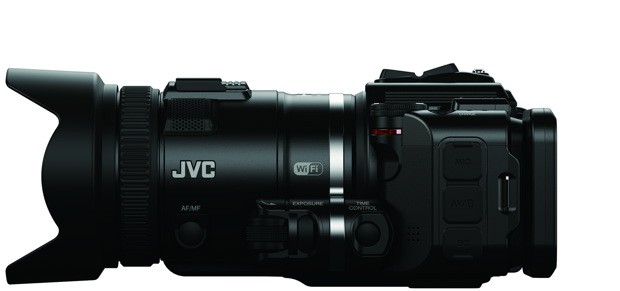
When it comes to launching a groundbreaking flagship video camera at CES, JVC's got previous experience. The company has outed the Procision GC-PX100, a 1,920 x 1,080 camcorder that shoots at 36Mbps, a bit-rate that the company claims makes it perfect for slow-motion and special effects work. Light will be pouring forth into a F/1.2 lens, a 1/2.3-inch 12.8-megapixel backside illuminated CMOS censor with optical image stabilization. JVC is claiming that it's capable of cranking out 600 frames per second and shoot still images in bursts of nine frames a second -- although not at the same time. When you're done, you can push the footage straight to your smartphone or tablet over WiFi and the company is also offering a mobile app that'll let sports coaches analyze their players movement in staggering detail. It'll be available in March, but you'd better all of that athletic scrutiny is worth it, as it'll set you back $1,000.
At the same time, the company's outing a game of Everio camcorders, with the entry-level GX-E100 setting you back $230 for the most basic model the company can offer. At the other end of the range, the $500 GZ-VX815 offers a f/1.2 lens, a 12.8-megapixel sensor and WiFi when it goes on sale in March.
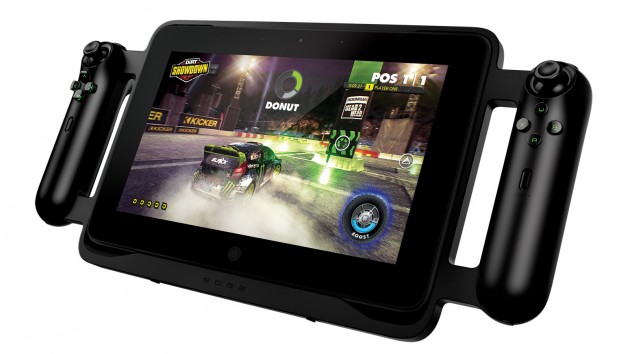
If you’re a fan of gaming and enjoy tablets, the Razer Project Fiona PC gaming tablet concept could be the device for you. As a fully-featured PC and tablet in one, the tablet PC offers the ability to run all games and applications thanks to its four modes designed for gamers.
The tablet series was introduced at CES 2012, and features Windows 8. There will be two versions: the Razer Edge and the Razer Edge Pro model. The Edge offers an Intel Core i5 processor, NVIDIA GT640M LE GPU, 4 GB of DDR3 RAM, and a 64 GB SSD. The Edge Pro sports an Intel Core i7 processor, NVIDIA GT640M LE GPU, 8 GB of DDR3 RAM, and between 128-256 GB SSD.
Both models will be on shelves in Q1 2013, with the base model starting at $999.
Samsung has a new Exynos 5 Octa Processor, and it’s absolutely wild. The company announced its new technology on Wednesday, saying that the Octa takes advantage of two sets of four core processor, all in your tiny little smartphone. It’s probably a safe bet this will power the company’s highly anticipated Galaxy S IV.
The company said its new chip uses ARM’s big.LITTLE processor tech—ARM Cortex-A15 for performance, and Cortex-A7 for common tasks. That should lead to better battery life, and an enormously smooth experience when playing games or simply browsing the Web. The future of mobile devices is looking brighter by the day. Samsung is already one of the leading companies in the world, and that’s likely to continue as we get settled in 2013.
Samsung says that being able to switch between performance and energy efficiency makes for a 70 percent increase in battery life. In addition, users should expect twice the 3D performance of something like the Exynos 4 Quad, which should do a lot to whet the palette of Android-gaming fanatics.
We can’t wait to hold a device using Samsung’s new Exynos 5 Octa. Hopefully we’ll start to see more information hit the Web in the coming weeks and months.
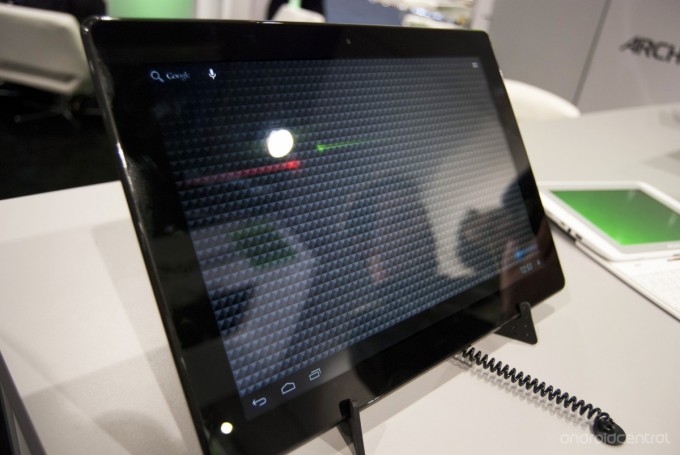
Well that was quick. Just a few months after Archos introduced their behemoth, family-sized FamilyPad to the UK, the company is here in Las Vegas showing off their follow-up, the FamilyPad 2. Archos was tight-lipped on specs and specifics, but recent rumors suggest the FamilyPad 2 will feature a minor processor bump with a 1.6 GHz Cortex A9-- up from the original's 1 GHz A8. The other major improvement is in onboard storage-- look for 16GB here rather than eight. Based on what we saw today, it looks like the FamilyPad 2 will ship with Jelly Bean, a welcome addition.
Aside from the minor bumps, the rest of the specs look to be the same, including 1 GB of RAM and that behemoth 13.3-inch IPS display. It's a beauty, despite its relatively low 1280 x 800 resolution. As you can see in the video below, handling this thing takes some flexibility, as the sheer size and weight make one-handed operation downright impossible. Make no mistake about it: this thing is a beast, and puts on no airs about being portable or lightweight.
The upside of its huge size is its multimedia capabilities-- watching videos, movies, and streaming content will look gorgeous, and the FamilyTab 2 is large enough for multi-person viewing. As you can see, Archos had it on a nice stand, which in your home would make the FamilyTab 2 a nice small television replacement.
Performance wise, everything seems up to snuff, though we would have loved to test out some games, which this tablet will certainly be ideal for. With Jelly Bean onboard and a more-than-capable processor, I wasn't able to find any lag or serious problems with the basic UI, though we'll reserve judgment until we get one in our home.
As always, we'll keep our eyes peeled for a proper spec sheet, release and pricing information. More photos and a hands-on video can be found after the break.
We knew we'd be seeing 3M Touch Systems'monster capacitive display once again, but we had no idea just how massive this year's iteration would be. Taking up residence in a corner of CES Unveiled 2013, the company's latest multi-touch prototype now measures in at 84 inches, far surpassing its 46-inch predecessor, with 100-inch versions waiting in the wings. This particular touch table now supports Ultra HD resolution (4K) and was shown running a software demo currently in use at Chicago's Museum of Science. As you may be able to tell from the accompanying gallery, those floating images aren't of the crispest quality, but that's because the files aren't fully high-res. Of course, tech of this kind isn't necessarily intended for households -- not yet, anyway -- it makes for a more natural fit in commercial environments (think: airports, car dealerships or wireless retailers). At present, the table here on the showfloor is calibrated to support 40 individual touch points, but a company rep assured us it could be configured for up to 60, allowing for large groups of people to interact simultaneously. While touch tabletops of this kind are still quite rare in the wild, expect to see them crop up more commonly in the near future. Check out a video demo past the break.
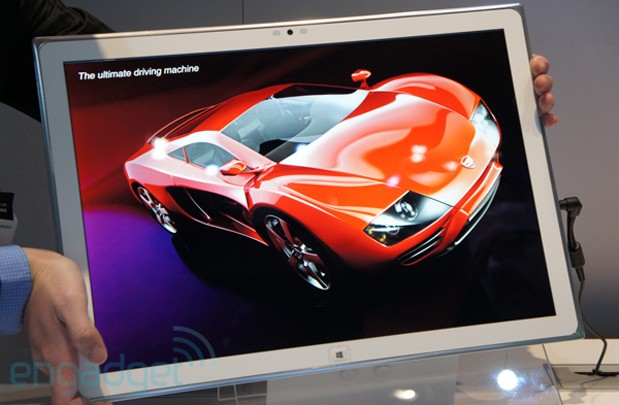
The Panasonic liveblog was barely finished when we saw this beauty calling out to us from the show floor. This is Panasonic's 20" 4K tablet, running Windows 8. It's a prototype design right now, but seemed to be pretty well put together, and not something quickly knocked up for the show. Given that it's not a full release model, details on specifications are sparse, but we can tell you that as well as that truly jaw dropping display, there is a front facing camera (no details on resolution, but possibly 2-megapixel), and an Intel Core i5 running the show. Input / output wise there wasn't a lot going on, but there was micro-USB, microSD and at least WiFi. If you're thinking that that display is going to pretty much keep you tethered to a wall to keep it powered, then we were told that it will at least give you two hours of use on the go.
Panasonic also told us that Anoto digital writing technology features in the tablet, which makes sense given that -- judging by the display section for this device -- that the tablet is aimed at marketing professionals, architects, photographers and other such business users. Given the tablet's size, it's not the sort of thing you are likely to be slinging in a rucksack and taking out on the road. That said, in our time with it, picking it up and moving it about wasn't terrible, and you can imagine swanky design houses and media companies lining the walls of their offices with these things. No word on price or availability, but Panasonic were confident that this would make it to production.
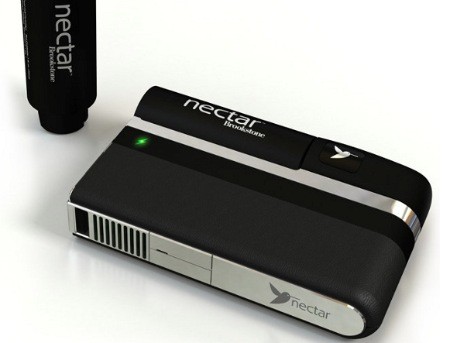
The Nectar mobile power system had its debut earlier this week at CES' Unveiled pre-show, and if nothing else, it's an impressive boast: The system claims to provide up to two weeks of power for your devices (including the iPhone) from a pack that fits very easily in a pocket. It's a pretty wild idea -- obviously, we haven't gotten a chance yet to really run the device through its paces just yet, but if the Nectar can do what the company says it can, it could be a very handy addition to your travel kit.
The way it works is that you buy the core base unit for US$299, and then you can pick up extra fuel cell units for just $10 each. Use up the included fuel cell, and you'll have to replace it, but that much power should definitely be handy if you need it all while out and about. Other fuel cell tech like this can be heavy and bulky, but Nectar is designed to be both very portable and very powerful.
The units will be available for sale at Brookstone later on this year, and we'll try to grab one then to see just how these claims stack up under trial. In the meantime, Engadget has a nice gallery of the unit showing just what it looks like in person.
Our sister site, Engadget, got a chance to try out the iSmartAlarm, which is a Wi-Fi camera set with LED lights that send an alert to your iPhone if it detects movement in your home. There's a number of options, including being able to see the movement, call 911 or just ignore it. You can also get a remote tag (the site boasts it will track children and pets), motion sensor and contact sensors for use in a window or door.
We've tested a number of home security systems that work with iOS, most recently the SwannSmart ADS-450 WiFi Network Camera. With a sub-$100 entry price -- the camera is $79, Engadget reports -- this system might be attractive to those looking for an iOS-based security system. iSmartAlarm is seeking funding through IndieGogo, however the page is not active yet.

 Speaking to the Shanghai Evening News, Apple's marketing boss Phil Schiller ruled out the possibility of a cheap phone from the Californian company.