Steve Ballmer is “Super-Glad” Microsoft Built Surface, Thinks Windows 8 Adoption is “Perfect”

Steve Ballmer sat for a spell with MIT Technology Review to discuss the Windows 8 ecosystem.

It’s no easy task to gauge the impact Windows 8 is having on the industry, in part because the industry is changing. The traditional desktop is taking a backseat in popularity to mobile form factors, like notebooks,tablets, and hybrids. Windows 8, as you know, is an attempt to bring all these devices together, along with smartphones, under a unified user interface. IsMicrosoft happy with its strategy up to this point?

Jason Pontin, MIT Technology Review’s Editor-in-Chief, had a chance to speak with Steve Ballmer about Windows 8 and related topics. One of the questions he asked is what Ballmer feels is a reasonable adoption period for a new version of an operating system that’s to be used by a billion people.

“Well, it’s a complex question. You’ll need to define what you mean by adoption rate. It’s affected by three things: How many do we sell? How quickly do people retire the installed base that they own? And what are the similarities and differences between the consumer market and the corporate market?,” Ballmer said. “In the first 10 weeks, we sold 60 million copies. All new consumer PCs are now Windows 8 based. So in that sense, I would say that here the adoption rate is perfect.”

Ballmer pointed out that consumers upgrade PCs less frequently than phones but upgrade them more frequently than TVs and game consoles. And in the corporate world, “adoption is always a little slower.”

And what of Microsoft’s Surface strategy?

“I’m super-glad we did Surface,” Ballmer said. “I think it is important — and not just for Microsoft, but for the entire Windows ecosystem — to see integrated hardware and software….Surface is a real business. In an environment in which there’s 350 million PCs sold, I don’t think Surface is going to dominate volume, but it’s a real business.”

[Source: TechnoBuffalo]

Apple Seeds iOS 6.1.3 Beta 2 to Developers, Fixes Passcode Security Issue

Apple’s iOS 6.1.3 beta 2 is rolling out, and it reportedly fixes that awful security lock screen bug. According to 9to5Mac, the beta might also squash recent jailbreaks, though this has yet to be verified. Apple has been kicking out incremental updates over the last few weeks at a pretty high clip. Let’s hope that when iOS 6.1.3 is rolled out, something new doesn’t break along with it.

[Source: TechnoBuffalo]

New Apple 'iWatch' Patent Application Reveals Slap Bracelet with Wraparound Touch-Sensitive Display

A newly-published patent application from Apple discovered by AppleInsider discloses a new "bracelet" accessory with a wraparound design where the screen would cover the entire outer surface. While the word "watch" is not used anywhere in the patent application, which was filed in August 2011, the "wearable video device" described in the document could clearly serve as an advanced wristwatch.

The patent application describes a "bi-stable spring" design, where the watch strap would automatically curve snugly around any sized wrist, the two ends overlapping as required. The display itself would be flexible, and the patent describes a method by which any portion of the display covered by the overlap could be automatically switched off.

The device's screen is described as having a "touch-sensitive user interface" overlaid on the flexible display, in contrast to the physical buttons used on existing smart watches like Pebble.

The design comprises a thin flexible steel band within a fabric wrap, with the screen glued to the outer surface and the electronics and battery glued to the inner surface, though it also refers to the possibility of a more robust design with a fabric frame surrounding the display.

The display appears to be made up of a series of flexible segments which would be flat when the watch is placed on a desk but which curve as much as needed to fit the wrist when the watch is worn.

The patent application also gives clues as to the possible size of the watch, suggesting a width of one inch. though it should be noted that this refers only to the 'typical' width of such bracelets rather than any specific plan by Apple:

The most recent widespread use of such a device was the slap bracelet, also called the slap wrap. The slap bracelet consists of layered flexible steel bands sealed within a fabric cover. Typical slap bracelets are roughly one inch in width by nine inches in length. In a first equilibrium position they can be flat. The second equilibrium is typically reached by slapping the flat embodiment across the wrist, at which point the bracelet curls around the wrist and stays relatively secure in a roughly circular position.

The patent suggests that gyroscopes and accelerometers would be used to allow the watch to determine the orientation of the display, depending, for example, on whether it was worn on left or right wrist.

The patent application also lends weight to speculation that the watch would be a partner device to an iPhone rather than a standalone product, as it refers to "a method for passing information between an accessory device disposed on one surface of a bi-stable spring substrate and a portable electronic device." The watch would act as an input device as well as a display, with reference to a virtual keyboard.

While plugging in the watch to a power source appears to be the primary means of charging the battery, the patent also discusses options for solar power and kinetic charging of the battery, two technologies Apple has addressed in previous patent applications.

Many of Apple's patent applications of course never come to fruition in the form of released products, with Apple instead seeking to control certain technologies or aspects of devices that may appear in completely different forms. As a result, it is unlikely that Apple has plans to launch such a slap bracelet watch accessory, but the patent application does give some insight into what Apple has been considering as it has worked on the project.

[Source: MacRumors]

Ubuntu Touch Developer Preview Available Now

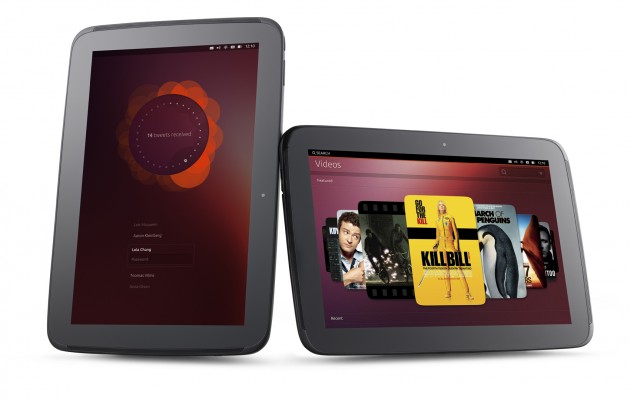
Well that was fast. Canonical, the parent company behind Ubuntu, recently announced itsintentions to provide Ubuntu for tablets, in addition to its goal to launch Ubuntu smartphones in 2014. Good news, tinkerers: the developer preview of Ubuntu Touch is now available for download.

Ubuntu promises the software, which is available for the Galaxy Nexus, Nexus 4, Nexus 7 and Nexus 10, will provide support for WiFi, GSM network connections, functional cameras and the shell and core applications needed to experience the software in full. You’ll need to have some coding chops to get started, however, since there are a few commands required. You also have to make sure your device is unlocked so that Ubuntu can access the bootloader.

Thankfully, if you don’t dig the experience and want Android back, it’s as easy as downloading the factory image and reflashing it to your device. If you run into troubles along the way, you can join the company’s mailing list or head over to its IRC channel at irc.freenode.net and joining the #ubuntu-phone channel.

[Source: TechnoBuffalo]

Google’s Chromebook Pixel is a Premium Chrome OS Laptop That Starts at $1,299

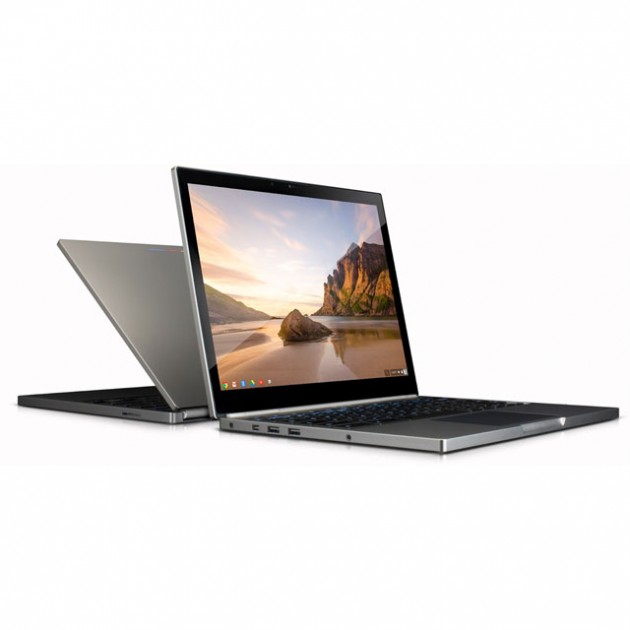
That mysterious Chromebook Pixel laptop we saw is real and it costs $1,299. That’s a hefty price tag for a device with only 32GB of storage (the 64GB model with LTE is $1449). But the screen… the 12.85-inch (3:2 aspect ratio) display has 4.3 million pixels with a 2560 x 1700 resolution (239 ppi). For comparison, the 13-inch MacBook Pro’s screen has a density of 227 ppi.

Google says the Chromebook Pixel “is a laptop that brings together the best in hardware, software, and design to inspire future innovation.” The screen itself has a 0.55mm layer of touch-enabled Gorilla Glass, allowing users to swipe and tap just as they would on a tablet. Google is simply taking that familiar tablet experience and transferring it over to the Chrome OS environment on a 3:2 screen it says is “designed for the web.”

Even though it has 32GB of onboard storage, Pixel owners will get 1 terabyte of Google Drive cloud storage for free for 3 years, so this is still firmly a cloud device. Whether PC users are still willing to only live (or mostly) in the cloud is up for debate. And beyond that, whether they’ll be enticed over to Google’s Chrome OS environment for a high res screen is a hard sell.

The Pixel body is engineered from machined aluminum with “nothing extraneous to distract you.” That means vents are hidden, screws are invisible and speakers are discretely tucked away. Google said there’s also a “piano hinge” for easy opening and closing, which also augments Wi-Fi and acts as a heatsink.

Full Pixel specs include a dual-core 1.8GHz Intel Core i5 processor, 4GB DDR3 RAM, up to 5 hours of batter, Bluetooth 3.0, 2x USB 2.0, mini display port, and 2-in-1 card reader (SD and MMC). This is a full-powered laptop, and not a $200 “additional” machine as Chromebooks have traditionally been. However, for $1200 starting out, there are plenty of other machines you can buy with more robust software.

You can purchase the Chromebook Pixel now from the Google Play store, and it’ll ship in 3-5 days.

[Source: TechnoBuffalo]

Netflix 3.0 for iOS brings UI improvements

Netflix has been steadily improving its iOS app since it debuted back in 2010. The latest version hit the app store yesterday and includes a few tweaks that improve the overall experience of the app.

Netflix 3.0 includes a new iPad-only feature that'll display the title of the TV episode or movie that you are watching when you tap on the screen. Users will also notice that Netflix revamped the layout for the play/pause/back buttons, making them easier to use. Lastly, Netflix brought back the zoom icon so you can easily jump to fullscreen mode.

You can grab the Netflix app from the iOS App Store for free. It requires a monthly Netflix subscription, which starts at US$7.99 per month.

[Source: TUAW]

PlayStation 4's UI and inner workings detailed: No more booting, games download as you play them

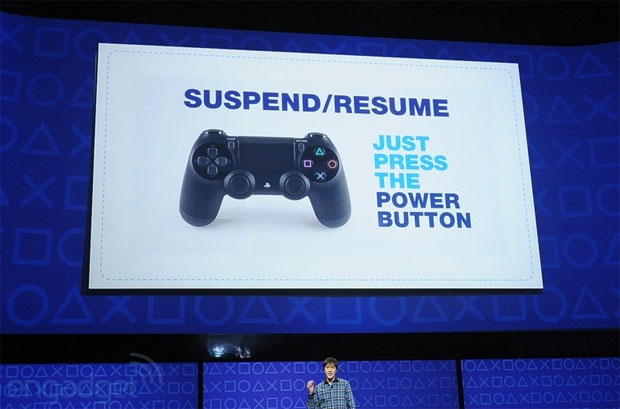
We've heard some hardware numbers, but now we're hearing more how thePlayStation 4 will actually work in practice. Alongside connections to other Sony hardware, the highlight that caught our attention was that you'll be able to leap back into your game by pressing the power button. From off. Better still, there's also a secondary custom chip for uploads and download and with that, the PS4 will let you play your new titles as you download them. The rest of the game will continue to be piped into that ample hard drive. You can also share (with that new button) 10 seconds of video, trimming and uploading your own gaming highlights to your buddies -- heck, you can even stream it, with allies 'tagging' in and taking over the controller.

In fact Sony will make social networks far more integrated, with "real people", photos and companion mobile apps to augment this. In fact you'll be able to browse video remotely from the likes of your smartphone, tablet or Vita. The system itself will also learn your preferences and download content it reckons you'll like. Personalization is shaping up to be a big focus for Sony.

[Source: Engadget]

Sony's new DualShock 4 controller official: all-new design, touchpad, share button and more

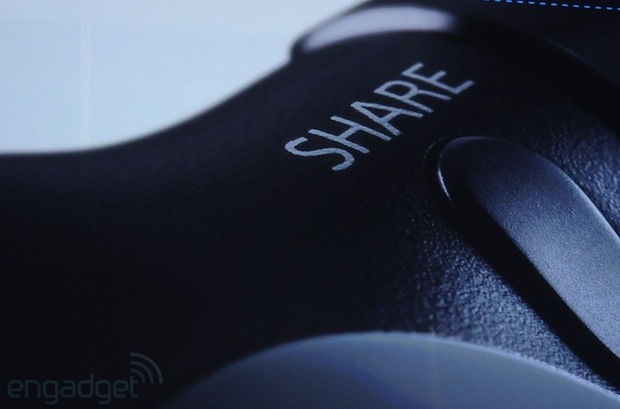
We had a hint or two about its imminent arrival, but Sony's now made its next-generation DualShock 4 controller official at tonight's PlayStation 4 event in NYC. The company's Lead System Architect Mark Cerny took to the stage to reveal the all-new companion, which has been redesigned and now features a more rounded form factor as well as what appears to be a slightly rubberized grip with "enhanced rumble capabilities." There's also a touchpad now (clearly taking a cue from the Vita), a headphone jack, the long-rumored share button, a light bar that, according to Cerny, will be utilized as a "more friendly way to identify players" and a stereo camera which is used to track the 3D position of the Move-compatible controller.

Not surprisingly, Sony's touting the addition of the "Share" button as one of the biggest features of the DualShock 4, allowing players to easily send tidbits like video clips and screenshots to places such as Ustream, Facebook and, naturally, the firm's own PlayStation Network. That's all we know thus far, but we''re sure to hear more about the DualShock 4 in the coming future -- for now, head on past the break and enjoy the gallery from Sony's presentation.

[Source: Engadget]

PlayStation 4 will not have native PS3 backwards compatibility

During today's PlayStation event Gaikai's Dave Perry revealed that the PS4 will not natively support PS3 games and that Sony's next-gen console will instead stream PS1, PS2 and PS3 games from the cloud -- something that the company has already confirmed on Twitter.

[Source: Engadget]

Sony unveils its next game console, the PlayStation 4

Sony tonight announced its much-rumored next video game console, the PlayStation 4. Sony Computer Entertainment prez and CEO Andrew House announced the console with little more than a logo and a handful of concepts, though he did say it's coming in holiday 2013. We're sure to hear more as the night goes on, and we'll be updating this post as we learn more.

Lead system architect Mark Cerny -- legendary game dev and, to us, creator ofMarble Madness -- came up next. He said that development of the PS4 started five years ago. Cerny said he's been exploring how to evolve "the PlayStation ecosystem," and he started by speaking to the limitations of PlayStation 3. Cerny said he's been aiming to make sure "nothing gets between the platform and the game." An image of an old-timey hunter shooting space invaders in the sky is used as an example -- here's hoping the PS4 doesn't mean we'll be taking plastic guns and shooting pixels in the sky.

"We were able to create in PlayStation 4 a system by game creators, for game creators," Cerny said. As far as specs, he said it runs on x86 architecture, a "highly enhanced" PC GPU (with "almost 2 teraflops of performance," he added), an unknown amount of local HDD storage, and 8GB of GDDR5 system memory. Cerny next unveiled the DualShock 4, which looks an awful lot like the leaks we saw recently -- it features a touchpad, a light bar, and what looks like rubberized grips. Otherwise, it looks an awful lot like a DualShock 3 with some new bells and whistles.

Cerny's talking software now -- the PS4 can pause and resume mid-game, allowing players to multitask at any point. There's also a second chip dedicated to managing uploads and downloads, meaning you can download games in the background or when the system's off. More importantly, however, you can start downloading a game and begin playing it as the download goes -- pretty great! As far as sharing goes, PS4 is heavy on social interactivity; Cerny said its social network will extend beyond the console to mobile and Vita. He's ambiguous about which platforms that'll mean, but it sounds like Sony's aiming to make it platform agnostic. There's also a Pinterest-esque social app for friends to share screens and video, which Cerny said applies to the PS4's "personalization" angle. "You'll see real pictures of your real friends," he said.

[Source: Engadget - Click here to read the full sory]

Vodafone, O2 and Three win 4G, but auction falls £1.2bn short

O2, Vodafone and Three have all won slices of 4G spectrum, meaning networks other than EE can begin rolling out speedy data services this year.

This morning Ofcom confirmed that after more than 50 rounds of bidding, every major UK network has walked away from the now-concluded 4G auction with barrelfuls of bandwidth, including spectrum that was freed up in the TV digital switchover.

Vodafone was the biggest bidder, splashing out nearly £800m for a pair of 10MHz slices in the 800MHz band, as well as other bits of bandwidth that will enable it to offer faster mobile data to customers. BT was the lowest bidder, but managed to nab some bandwidth.

Although EE is already running a 4G network using 1,800MHz bandwidth it already owned, the operator -- which owns Orange and T-Mobile -- paid just shy of £600m to pick up even more spectrum.

It's hoped that more networks offering 4G will cause a price war that results in cheaper tariffs for phone buyers. Three has fired the first shot already, promising that it will roll its 4G network into existing coverage, without raising prices.

Meagre cash for Britain

Ofcom boss Ed Richards called the auction's result a "positive outcome for competition in the UK", but the amount of cash generated by bidding networks was substantially lower than expected, which is bad news for the UK.

The total cash generated was £2.34bn. That's nothing to sneeze at, but is well short of the £3.5bn the auction was expected to raise. Moreover, Chancellor George Osborne had already factored the expected sum into the nation's budget this year, making it appear that the UK's deficit would fall in 2013. That leaves the treasury £1.2bn short of its expected target. Take it away, Picard.

[Source: CNET]

Google Glass maps, translation and more shown off in new vid

Google's futuristic 'Glass' eyewear is slowly but surely coming into focus, with the Big G releasing a new video that gives a clue as to how the space-age pince-nez will function.

In several scenes, real-time GPS is shown to be feeding maps data into the eyepieces of Glass wearers, so you can see where you are on a map while driving or cycling.

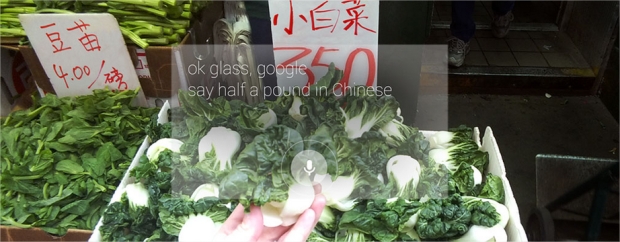
The video also suggests that commands are summoned by saying "OK Glass", which calls up more voice-activated commands, including "Google", "Take a picture" and "Record a video".

It seems you won't need your hands for photographical functions then, but the futuristic specs are also going to include touchpad controls, which may come in handy for more sophisticated tasks.

Translation is another touted feature, so you could use Google's voice search to demand instructions on how to say a word in French, for instance.

Google's original 'One Day' trailer for Google Glass was a lot more ambitious, featuring icons that bob in front of your eye and other high-tech treats that likely won't be available when Google Glass eventually goes on sale.

I think it's good to see the search giant talking in more practical terms about what its glasses will be capable of. A new site explains some of its features, and opens the doors to fans who want to be among the first to use the new technology, if you can impress Google with your combination of words, pictures and relevant hashtags.

Better still, it reveals that Google Glass will come in black, grey, white, blue and orange! Hooray for colours!

[Source: CNET]