New Retina MacBook Pro Processor Bumps Offer Minor 3-5% Performance Improvements

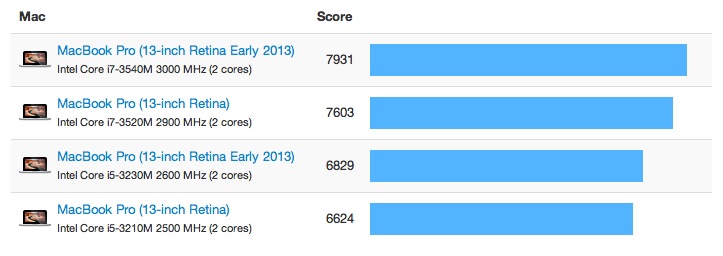
Following last week's introduction of new processors for the Retina MacBook Pro lineup, Primate Labs has analyzed benchmarks coming in from the new machines through the company's popular Geekbench 2 software. 

Unsurprisingly, the benchmarks reveal a roughly 3-5% increase in Geekbench scores for each of the processor bumps. For the 15-inch Retina MacBook Pro lineup, Apple bumped each of the three available processors by 100 MHz, accounting for the minor benchmark improvements. 
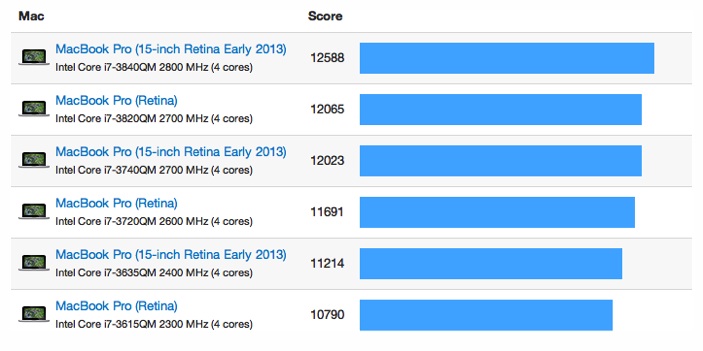
 

One thing to note is that the new mid-range Retina MacBook Pro has the same speed processor as the old high-end Retina MacBook Pro. However, the new mid-range model is slightly slower than the old high-end model. While this seems surprising at first, the difference is easily explained by comparing the two processors: the old high-end processor has more cache than the new mid-range processor.

For the 13-inch lineup, the 100 MHz speed bumps were limited to machines based on the high-end stock configuration starting at 256 GB of storage, with those machines also seeing a 3-5% improvement in Geekbench scores. 

Aside from the processor improvements for the Retina MacBook Pro lineup, Apple also reduced pricing on the 13-inch models by $200-$300, increased RAM on the high-end 15-inch stock configuration, and reduced pricing on storage options.

[Source: MacRumors]
More than 7m Brits are yet to use the Internet, government says

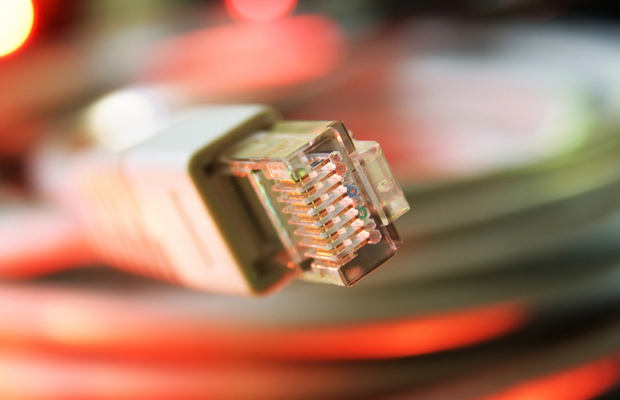
You might hate me for saying this (if you're over, say, 25), but I genuinely can't remember a world without the Internet. But it seems 15 per cent of UK adults have managed to avoid it completely -- more than 7.4 million Brits have never used the Web, according to an official report from the Office for National Statistics.

While those figures may sound surprising, the majority of the population who have yet to experience the wonders of the Internet are aged 75 or over. Internet use is highest among those between the ages of 16 and 24, of course, with very nearly 100 per cent of the population having used the Web. There were still 53,000 among the younger generation who had not, however, with poverty the main cause.

300,000 people who have not accessed the Internet put this down to earning less than £200 a week -- in stark contrast to the 100 per cent earning over £2,000 who are plugged in.

More and more people are accessing the Internet all the time though, with 1.2 million users having connected to cyberspace since last year.  

The report showed men were also more likely to use the Web, with 12 per cent of men having never been online as opposed to 16.9 per cent of women.

The older generation was not the only demographic with a particularly high proportion of people having never used the Internet: 32.8 per cent of people with disabilities live offline.

The report revealed that, unsurprisingly, single people were most likely to live their lives online with just 5.2 per cent having never accessed the information superhighway (you may have noticed I'm running out of synonyms here).

The problem with the social divide of Internet users could soon become much worse, with many government services being moved to its online portal. The first major service to get a 21st century overhaul will be the Department of Work & Pensions' Universal Credit project, which will combine six benefits into one, that can then be managed and claimed online.

[Source: CNET]

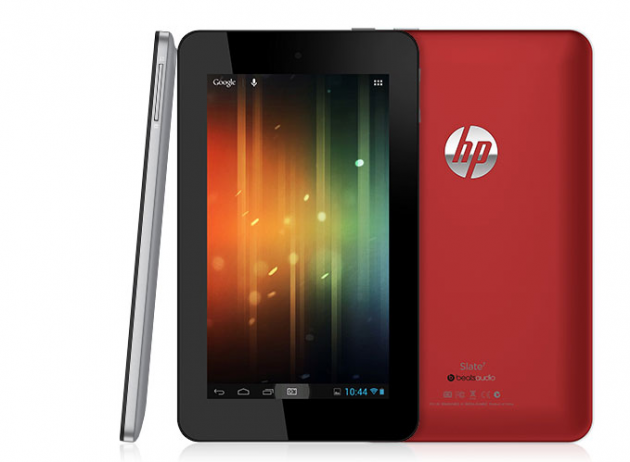
HP Slate 7 Android Tablet Revealed – Launches in April for $169

On the eve before Mobile World Congress officially kicks off in Barcelona, HP announced its first Android tablet, the Slate 7.

The device is a relatively mid-range 7-inch tablet with a 1024 x 600-pixel resolution. It packs a 1.6GHz dual-core processor, Android 4.1 Jelly Bean, Beats Audio support, a 3-megapixel camera, a VGA front-facing camera for video chat and 1GB of RAM. It packs just 8GB of storage, however.

The real meat of the story here is that HP is re-entering the tablet space after its failed launch of webOS powered tablets. The Slate 7 is expected to launch in April for a budget-friendly price of just $169. We’ll be trying to find one here at Mobile World Congress to bring you a closer look.

[Source: TechnoBuffalo]

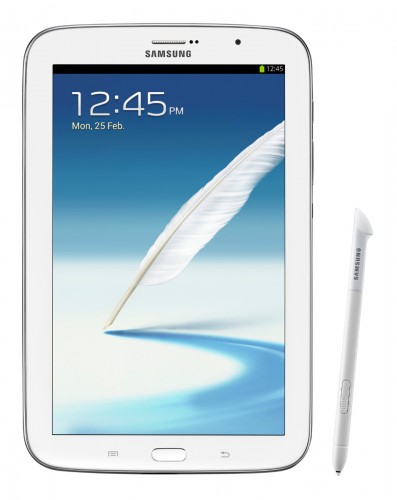
Samsung Galaxy Note 8.0 now official

Samsung has stepped forward and officially announced the Galaxy Note 8.0. We've sen and heard enough leaks and rumors to know that we would be seeing an 8-inch version of the popular Note series, but tonights' news clears up al the speculation and replaces it with information direct from Seoul. 

The Note 8.0 takes everything you love about the Note series, adds some great new features, and packages it all into a solid tablet form factor. The Note 8.0 will still be able to make phone calls in some countries, but the 8-inch screen puts this one squarely into the portable tablet genre. And that's a good thing. Users who didn't want a full-sized 10-inch tablet, but still wanted access to the great S Pen technology now have that option.

We've spent some time with the Note 8.0 on the eve of Mobile World Congress 2013, and have the answers to all your questions covered. The Samsung Galaxy Note 8.0 will be available world wide (Europe, Korea, North America, S.E. Asia, S. W. Africa, the Middle East, China, Taiwan, and Latin America) in Q2. Keep an eye on Android Central for exact dates and pricing. The full press release, press photos, and a Chat-On video featuring the Note 8.0 are after the break.

[Source: AndroidCentral - Read the full story here]

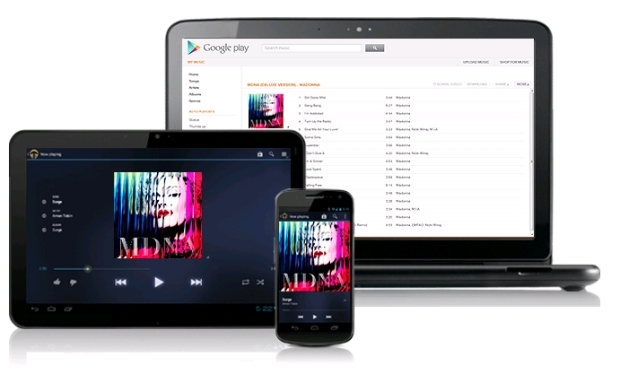
Google will launch a free music streaming service, FT says

As if branching out into hardware like phones and tabletsdriverless cars, and even augmented reality glasses wasn't enough, Google is also working on a free music streaming service, the Financial Times reports.

The service would try to drown out the likes of Spotify, Deezer, and Nokia Music. The launch is said to be "impending", so it seems Google is still just tuning up.

According to the FT, Google will offer subscriptions as well as free unlimited listening. Though you will have to put up with ads if you don't want to pay, just like on Spotify.

Why would Google go into unchartered territory then? Especially seeing as its Play Music service, which launched in 2011 as Google Music, is only available in the US and a handful of European countries. Well it's another way for Google to make money, seeing as at the moment 95 per cent of its revenues come from advertising. Streaming is big business, being one of the fastest growing areas of the music market.

Apple is also rumoured to be working on a streaming service, which would put it and Google in direct competition on yet another front. As if the smart phone war wasn't already bloody enough.

Google could preinstall the service on all Android devices. And seeing as the operating system is on three out of four smart phones, that should give Google quite some reach. Not that it wouldn't be short of competition though. I'm sure Spotify and its good buddy Facebook wouldn't be too happy about the Google boys crashing their party. The music industry is also no fan of Google -- just this week, the Recording Industry Association of America attacked the search giant for linking to pirate sites. It claimed Google had gone back on its promise to shunt such sites further down its search rankings.

[Source: CNET]

Twitter ratchets up phishing protection by adopting DMARC standard

Phishing emails often pose as being sent by major league sites rather than princes from far-flung countries, but Twitter's implemented a new measure to stamp out phonies that borrow its name. Costolo and Co. announced that, earlier this month, they began leveraging a tech called DMARC that establishes a way for email providers to authenticate senders and reject messages penned by impostors. While the DMARC specification does need support from e-mail services, outfits including AOL (which happens to be our parent company), Gmail, Hotmail / Outlook and Yahoo already make use of it. According to Twitter, it's now "extremely unlikely" that the majority of their users will receive emails masquerading as being sent from a Twitter.com address. We're sorry to disappoint, but it looks like you'll have to get your fix of foreign lottery notices from somewhere else.

[Source: Engadget]


iPad 5 Case for Rumored Redesign Surfaces

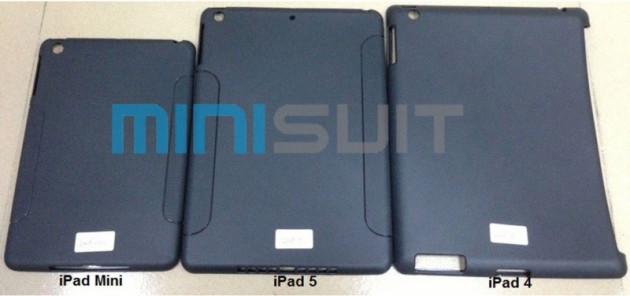
With numerous specs circulating for the iPad 5, it isn’t surprising that we have seen the first potential case surface.

Case maker MiniSuit has supplied MacRumors with an image of a case the firm has already made for the fifth generation iPad based off of specs it has received from a source. The case is similar to the leaked iPad 5 rear shell that surfaced back in Jan. that showed a relocated microphone. It also follows along with the rumors we’ve heard that the new tablet will share more design characteristics with the iPad mini, and also come in somewhat slimmer than the fourth generation iPad.

It is not unusual for case manufacturers to begin work on cases based solely on rumors. While they could end up being wrong, if they’re right, and able to get their cases to market quickly after the announcement, it can be a financial windfall for them.

Currently rumors for the release of the fifth generation iPad range anywhere from March to October, but June seems to be taking the lead as of late as the probably release window.

[Source: TechnoBuffalo

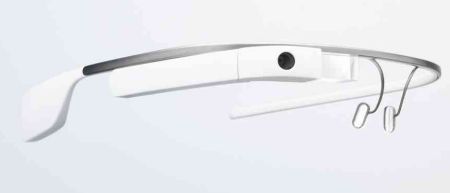
Google confirms Glass will work with iPhone

Google held an event this week to show off its upcoming "Google Glass" interactive headset/system, and from that meeting came one important note for us iOS fans. Google confirmed that the system will definitely workwith Apple's iPhone. The exact details of the relationship aren't clear, but there are of course a number of ways your iPhone could work with Google's glasses, from simply acting as a Bluetooth headset, to a more complex relationship with a Google app, sharing information or even an Internet connection back and forth.

Obviously, Apple and Google aren't on the best terms at the moment, with Apple forcefully uprooting its deal with Google Maps to go with a more native solution. But Apple's also been very open to having Google apps on the App Store, so Google may work out some sort of solution where Glass plugs in through the Bluetooth connection or even right through the Lightning connector.

At any rate, it sounds like your iPhone and Google Glass will play nice. Consumer versions of the Glass units are expected later on this year, though the price will be steep -- somewhere around US$1,500, according to the speculation. The tech will only get cheaper, so it might not be long at all before you're wearing your interactive glasses and connecting to your iPhone.

[Source: TUAW]

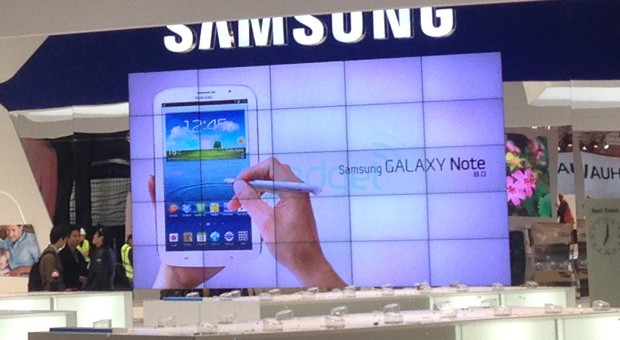
Samsung Galaxy Note 8.0 spotted at MWC, almost hides your entire hand

At last, here's what we've been promised: an 8-inch flavor of Samsung's Galaxy Note lineup. Spotted by an anonymous tipster on the MWC show floor earlier today, the booth shows off said tablet designed with portrait usage in mind, meaning it'll pretty much cover up most of whichever hand you'll be holding it with. And obviously, the Note 8.0 comes with a stylus as well. There's not much more to share at this point, but we'll be seeing this new device in its full glory very soon, so stay tuned. One more shot after the break.

[Source: Engadget]

Steve Ballmer is “Super-Glad” Microsoft Built Surface, Thinks Windows 8 Adoption is “Perfect”

Steve Ballmer sat for a spell with MIT Technology Review to discuss the Windows 8 ecosystem.

It’s no easy task to gauge the impact Windows 8 is having on the industry, in part because the industry is changing. The traditional desktop is taking a backseat in popularity to mobile form factors, like notebooks,tablets, and hybrids. Windows 8, as you know, is an attempt to bring all these devices together, along with smartphones, under a unified user interface. IsMicrosoft happy with its strategy up to this point?

Jason Pontin, MIT Technology Review’s Editor-in-Chief, had a chance to speak with Steve Ballmer about Windows 8 and related topics. One of the questions he asked is what Ballmer feels is a reasonable adoption period for a new version of an operating system that’s to be used by a billion people.

“Well, it’s a complex question. You’ll need to define what you mean by adoption rate. It’s affected by three things: How many do we sell? How quickly do people retire the installed base that they own? And what are the similarities and differences between the consumer market and the corporate market?,” Ballmer said. “In the first 10 weeks, we sold 60 million copies. All new consumer PCs are now Windows 8 based. So in that sense, I would say that here the adoption rate is perfect.”

Ballmer pointed out that consumers upgrade PCs less frequently than phones but upgrade them more frequently than TVs and game consoles. And in the corporate world, “adoption is always a little slower.”

And what of Microsoft’s Surface strategy?

“I’m super-glad we did Surface,” Ballmer said. “I think it is important — and not just for Microsoft, but for the entire Windows ecosystem — to see integrated hardware and software….Surface is a real business. In an environment in which there’s 350 million PCs sold, I don’t think Surface is going to dominate volume, but it’s a real business.”

[Source: TechnoBuffalo]

Apple Seeds iOS 6.1.3 Beta 2 to Developers, Fixes Passcode Security Issue

Apple’s iOS 6.1.3 beta 2 is rolling out, and it reportedly fixes that awful security lock screen bug. According to 9to5Mac, the beta might also squash recent jailbreaks, though this has yet to be verified. Apple has been kicking out incremental updates over the last few weeks at a pretty high clip. Let’s hope that when iOS 6.1.3 is rolled out, something new doesn’t break along with it.

[Source: TechnoBuffalo]

New Apple 'iWatch' Patent Application Reveals Slap Bracelet with Wraparound Touch-Sensitive Display

A newly-published patent application from Apple discovered by AppleInsider discloses a new "bracelet" accessory with a wraparound design where the screen would cover the entire outer surface. While the word "watch" is not used anywhere in the patent application, which was filed in August 2011, the "wearable video device" described in the document could clearly serve as an advanced wristwatch.

The patent application describes a "bi-stable spring" design, where the watch strap would automatically curve snugly around any sized wrist, the two ends overlapping as required. The display itself would be flexible, and the patent describes a method by which any portion of the display covered by the overlap could be automatically switched off.

The device's screen is described as having a "touch-sensitive user interface" overlaid on the flexible display, in contrast to the physical buttons used on existing smart watches like Pebble.

The design comprises a thin flexible steel band within a fabric wrap, with the screen glued to the outer surface and the electronics and battery glued to the inner surface, though it also refers to the possibility of a more robust design with a fabric frame surrounding the display.

The display appears to be made up of a series of flexible segments which would be flat when the watch is placed on a desk but which curve as much as needed to fit the wrist when the watch is worn.

The patent application also gives clues as to the possible size of the watch, suggesting a width of one inch. though it should be noted that this refers only to the 'typical' width of such bracelets rather than any specific plan by Apple:

The most recent widespread use of such a device was the slap bracelet, also called the slap wrap. The slap bracelet consists of layered flexible steel bands sealed within a fabric cover. Typical slap bracelets are roughly one inch in width by nine inches in length. In a first equilibrium position they can be flat. The second equilibrium is typically reached by slapping the flat embodiment across the wrist, at which point the bracelet curls around the wrist and stays relatively secure in a roughly circular position.

The patent suggests that gyroscopes and accelerometers would be used to allow the watch to determine the orientation of the display, depending, for example, on whether it was worn on left or right wrist.

The patent application also lends weight to speculation that the watch would be a partner device to an iPhone rather than a standalone product, as it refers to "a method for passing information between an accessory device disposed on one surface of a bi-stable spring substrate and a portable electronic device." The watch would act as an input device as well as a display, with reference to a virtual keyboard.

While plugging in the watch to a power source appears to be the primary means of charging the battery, the patent also discusses options for solar power and kinetic charging of the battery, two technologies Apple has addressed in previous patent applications.

Many of Apple's patent applications of course never come to fruition in the form of released products, with Apple instead seeking to control certain technologies or aspects of devices that may appear in completely different forms. As a result, it is unlikely that Apple has plans to launch such a slap bracelet watch accessory, but the patent application does give some insight into what Apple has been considering as it has worked on the project.

[Source: MacRumors]