Code in OS X 10.8.4 Suggests Future Macs Will Offer 802.11ac Gigabit Wi-Fi Support

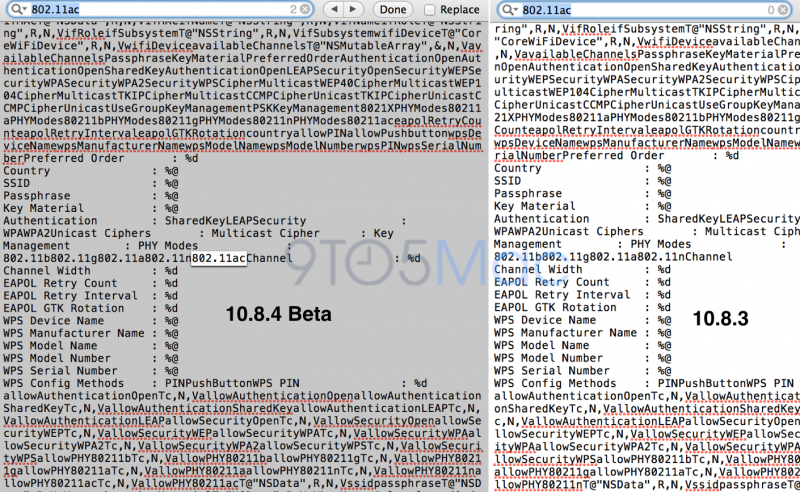
Code within the latest 10.8.4 beta release of OS X confirms that 802.11ac 5G "Gigabit Wi-Fi" support, which is not offered in OS X 10.8.3, will be offered on Apple's next generation Macs, reports 9to5Mac.
In January, Apple reportedly signed a deal with wireless chip firm Broadcom to bring the high-speed wireless access to its future Mac lineup. 

802.11ac offers triple the speeds that are available with the current 802.11n standard, supporting up to 450 Mbps on one antenna and up to 1.3 Gbps when used with three antennas. The speed boost allows for quicker file transfers between home computers. 

report from Digitimes earlier today suggests that Apple might be refreshing its notebook lineup near the end of the second quarter, which may translate to an introduction at Apple's annual Worldwide Developers Conference in June.

[Source: MacRumors]
AT&T announces 20 new LTE locations

AT&T dumps a bucket full of LTE location news, both currently active cities and coming soon announcements

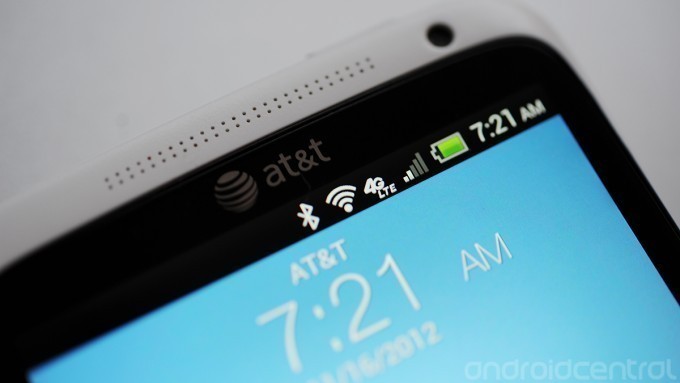
AT&T just sent out 20 press releases with a bunch of LTE announcements. There's a lot to digest, so allow us to break it all down in one place for easy reading.

New LTE cities that are currently active:

New LTE cities coming this summer:

There's no word on when exactly during the summer these will light up, but I'm sure AT&T will remind us again when they go live -- or you fine folks will let us all know the minute it drops.

[Source: AndroidCentral]

27-inch iMacs hit Apple's refurb store

Apple introduced its new thin iMac models last year and now those beauties have landed in the company's certified refurbished outlet. As reported by Engadget and MacRumorsthe refurbished 27-inch iMac is available for up to $270 off the regular retail price. The refurbished base Core i5 model sells for $1,529 and includes a 2.9 GHz Core i5 processor, 8 GB of RAM, a 1 TB HDD and a gorgeous 2,560 x 1,440 display. A 3.2 GHz Core i5 model is available for $1,699, and the Core i7 models are available starting at $1,869. Each refurbished model comes with a one-year warranty from Apple.

[Source: CNET]

Chrome for iOS now includes Google Cloud Print, AirPrint, and fullscreen browsing

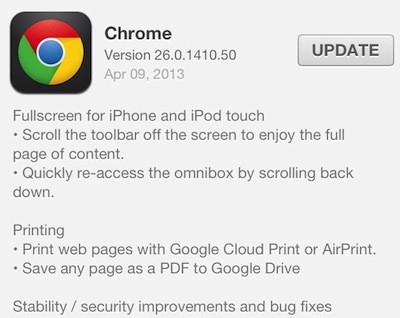
Google's Chrome browser for iOS (free) was updated to version 26.0.1410.50 today, providing some new and much-appreciated features.

To begin with, the app now provides support for Google Cloud Print, a way of printing documents to printers from just about anywhere through PCs or Macs that are aware of attached or wireless printers. The app also provides support for Apple's own AirPrint and AirPrint-aware printers.

Any page viewed in Chrome can also be saved as a PDF file to the user's Google Drive through Cloud Print. This is a way to quickly store web pages on Google Drive for download to an iOS device for offline reading.

In addition to the usual stability and security improvements and bug fixes, Chrome also adds fullscreen browsing support for the iPhone and iPod touch. This was implemented in a very intuitive manner; users simply scroll the browser window to the top of the screen to "push" the toolbar off the screen, or scroll back down to view the Google "omnibox."

While the changes are rather limited, they add a tremendous amount of utility to a fast and stable iOS web browser.

[Source: TUAW]

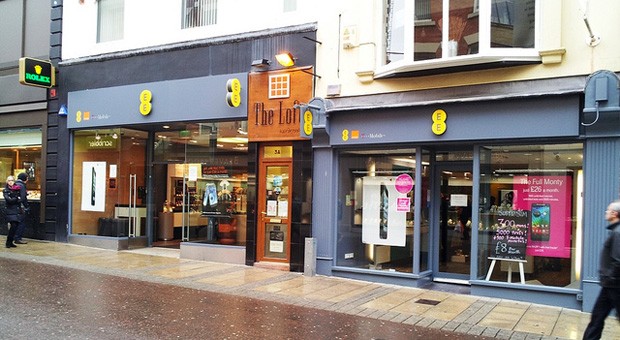
EE to double 4G spectrum allocation, boost speeds in first ten cities by summer

While EE scrambles to spread its LTE network far and wide before the other UK carriers get into the 4G business, it also wants to flex some spectrum muscle. The network's announced it's planning to double the LTE allocation on its 1800MHz band (from 2 x 10MHz to 2 x 20MHz), which it claims will increase download speeds to an average of 20 Mbps, topping out at 80 Mbps. Ten of the 11 original 4G launch cities will be seeing this bandwidth boost first: London, Birmingham, Bristol, Cardiff, Edinburgh, Glasgow, Leeds, Liverpool, Manchester and Sheffield.EE doesn't want you to think it's done expanding, though, and says it'll continue to make use of its MHz and GHz by rolling out boring, normal LTE in new areas whilst doubling up in others. The first ten cities are due to receive "double-speed" 4G by summer, which we assume means around the time summer is supposed to happen.

Update: EE's Howard Jones has added on Twitter that the network will start trialing carrier aggregation, LTE-A (that's even better 4G) later in 2013. We've asked for more details and will fill you in when we hear more.

[Image credit: Lazygamer, Flickr]

[Source: Engadget]

Free London Underground Wi-Fi for O2 customers

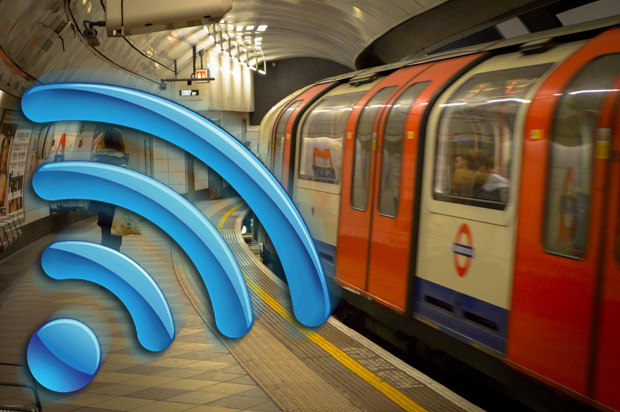
O2 customers will enjoy free Wi-Fi on the London Underground from the beginning of June, joining subscribers of Virgin Media, EE and Vodafone in not having to pay extra to get on the Intertubes while they're on the Tube.

Between the start of the London 2012 Olympics and the end of January, anyone with a Wi-Fi-enabled device could freely connect to the network, which is currently offered in over 100 stations across the Tube. After that period, Virgin Media turned its corporate focus to profits over positivity and locked down the service to its own customers, and those of networks who ponied up.

Now O2 has joined the party and struck a similar deal to EE and Vodafone, opening up the service for free to all its customers.

Customers of Three will be left disappointed -- it's the only mobile operator to not offer its customers free Wi-Fi on London's famous train network.

"Wi-Fi on London Underground has gone from strength to strength and we're delighted the majority of Londoners are staying connected for no extra cost," said Mark Williamson, head of Virgin Media's London Wi-Fi division.

Twelve more Underground stations can boast free Wi-Fi from this week -- Acton Town, Baker Street, Bank, Caledonian Road, Earl's Court, Holland Park, Ladbroke Grove, Maida Vale, Queen's Park, Sheperd's Bush, Sloane Square and West Ruslip.

[Source: CNET]

Facebook Home software leaks, try it out early

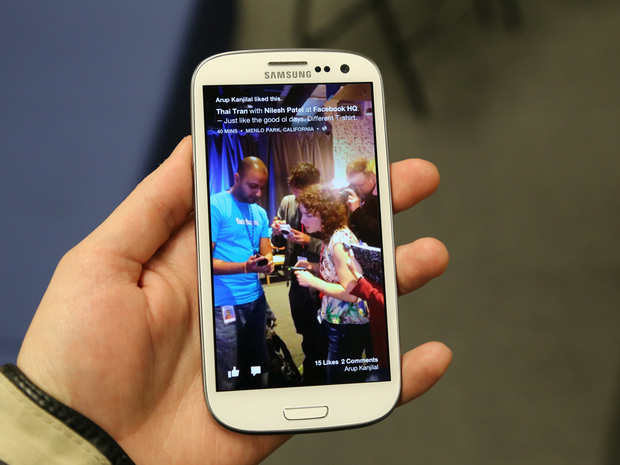
If you want to go Home early, now's your chance: a pre-release version of Facebook Home has leaked to turn your Android phone into a photo-liking, status-updating machine.

Facebook Home is software that completely replaces the interface on your Android phone, loading your friends' photos, posts and status updates on your homescreen. The software is showcased on the HTC First phone, but you'll be able to download it for a range of Android phones.

And ahead of the official launch, MoDaCo has pulled an early version of the software from the ROM of the HTC First, consisting of three APKs.

There's the main Facebook app, codenamed 'katana'; the Messenger app, codenamed 'orca', which integrates with your text messages; and a launcher shell app codenamed 'home'. To try out the pre-release software, including the floating head Chat Heads feature, you need to completely uninstall the existing Facebook app. The leaked software works on phones with a resolution lower than 1,280 x 768 -- and, as ever, you mess with the dark arts of leaked pre-release software at your own risk.

[Source: CNET]

Microsoft Ending Windows XP Support on April 8, 2014

Microsoft is finally closing the book on Windows XP on April 8, 2014 as it closes down support for the aging operating system.

Despite Windows Vista, Windows 7 and Windows 8 having all hit the market, there are stillcomputers out there running around with Windows XP as the operating system. Microsoft has already carried on support for the OS launched in 2002 longer than it normally would due to the popularity of the software, but all good things must come to an end.

Microsoft reminded everyone today that only 365 days of Windows XP support remain, and after that it will be a wild frontier for those who still continue to use the software. April 8, 2014 will mark the end of extended support which means that corporations will no longer be able to pay for support and that there will be no further software patches issued.

Considering we are in the 11th year of Windows XP, you can’t really blame Microsoft for finally shutting this down. It is honoring the support window from the release of SP3, and the 2014 date will mark a 12 years since the initial release.

If you’re still using Windows XP, and plan to do so past the cut off date, remember you will be doing so “at your own risk.”

[Source: TechnoBuffalo]

Intel announces faster next-gen Thunderbolt

Engadget is reporting that Intel has introduced the next generation of the Thunderbolt interface at theNAB conference. The update promises data transfer rates of 20 Gbps in each direction on Thunderbolt's two channels, twice the speed of the current generation rated at 10 Gbps. The demonstration Engadget witnessed showed the new Thunderbolt running at 1,200 Mbps, which is simply remarkable. Intel says the new Thunderbolt is also capable of simultaneous 4k video file transfer and display.

In addition to the improved speed, the company will be introducing thinner cables for devices in the next year. Current users shouldn't worry too much about obsolete accessories; the new Thunderbolt is backwards-compatible with previous connectors and cables.

Look for the new Thunderbolt sometime in 2014.

[Source: TUAW]

Blackmagic's Production Camera 4K gets full size cinema sensor, $3,995 pricetag

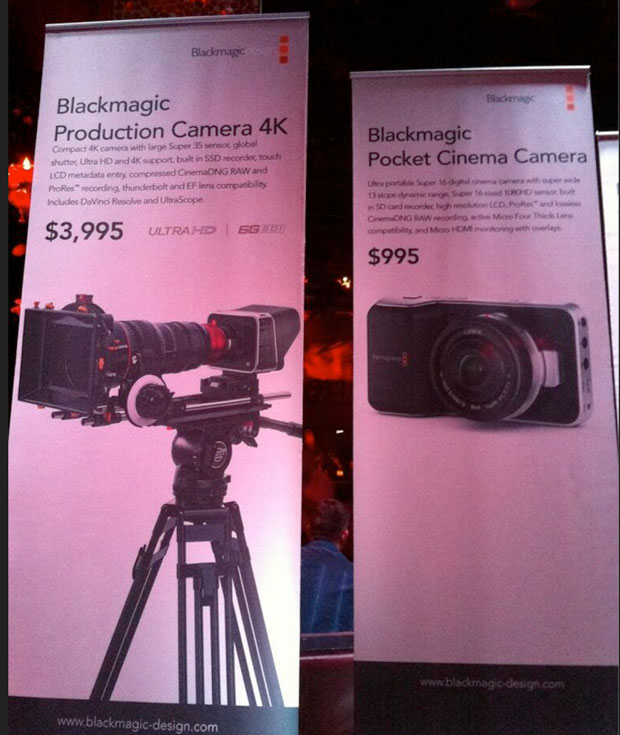
No matter how hard companies try and keep secrets, when it comes to trade show floors there's always the risk that someone will snap a picture and steal their thunder. The latest casualty is Blackmagic, which will be announcing both a Pocket Cinema Camera and this, its Production Camera 4K. We're fairly sure that this will sit above its Cinema Camera, offering a bigger Super 35 sensor, global shutter and Thunderbolt connector alongside the SSD recorder, touchscreen LCD and EF lens mount we found on last year's model. When the company gets around to announcing the hardware properly, it'll be available for $3,995 -- low enough to make even the most ardent of DSLR fans think twice.

[Image Credit: Danielo Garcia]

[Source: Engadget]

Sony unveils 30-and 56-inch professional 4K OLED monitor prototypes

The 56-inch OLED TV Sony trotted out at CES may not be headed to the consumer market, but it is becoming a reality, at least in the professional sector. The company showcased a pair of 4K OLED prototypes at NAB 2013, outing a 4,096 x 2,160 30-inch model as well as a 3,840 x 2160 56-inch display. Both panels boast of wide viewing angles and low color shift, promising accurate signal reproduction for industry professionals working with 4K content. No word yet on pricing, but professionals can look forward to upgrading sometime in next year. Sony also announced a refresh for its existing line of professional OLED displays. The A series will replace seven older skus, again promising better viewing angles and color shift than the previous generation. Hit the break for the official press release, item skus, and a quick break down of what products the A series will be replacing.

Update: The 30-inch 4K OLED prototype is looking at a 2014 release date, while the A series monitors will be available in May.

[Source: Engadget]

Nokia Lumia 928 leaks, thinner than the 920

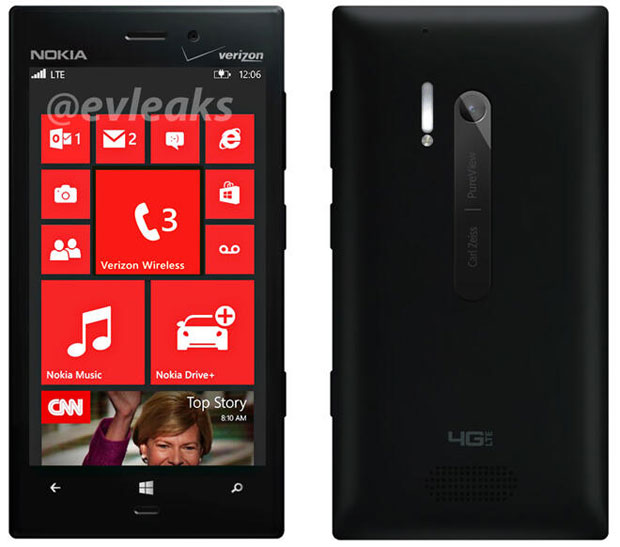
A new Nokia is on the cards, and this one promises to strip the Lumia 920 of its flagship status. Called the Lumia 928, it's leaked via the@evleaks Twitter account, and it's a slightly tweaked version of the 920.

The 928 is heading for US network Verizon, so I don't know whether us Brits will ever see it on these shores. Still, we can hope…

So what's changed from the Lumia 920? The two look very similar, but the 928 has a longer flash on the back. It'll also be slightly thinner, measuring 10.2mm at its thinnest point and 11.2mm at its thickest, with a slightly curved back, according to The Verge. Instead of an LCD screen, the 928 will sport a 4.5-inch OLED jobby. Other than that, the specs are near identical, with a 1.5GHz dual-core processor, 32GB of storage, and 1GB of RAM. Good stuff.

The Lumia 928 will eschew an aluminium frame in favour of a thinner polycarbonate one. It'll also reportedly have a new xenon flash as well as the same LED one as found on the 920. Lighting your snaps shouldn't be an issue, then.

It's expected to go on sale in the US later this month, but as I say, there's no word on whether it'll find its way across the pond.

The Lumia 920 earned itself a highly commendable four out of five stars in our review. But that's not as good as the wallet-friendly Lumia 620, which scored four and a half. Proof you don't need to spend big to get a decent smart phone.

[Source: CNET]