Apple gets defensive with new iPhone campaign

Apple has launched a new section of its website dedicated to singing the iPhone's praises. The timing is no surprise, seeing as Samsung has just lifted the lid on the Galaxy S4, which is the iPhone's biggest threat by far.

The Cupertino company also took the opportunity to fire a few potshots at rival operating systems. Which seems a bit defensive if you ask me.

The whole thrust of the page is how much people love their iPhones. Apple makes a big deal of the fact it's won eight straight awards from J.D Power and Associates. It bigs up the device's design too: "every detail and every material -- particularly the sleek aluminium enclosure -- has been meticulously considered and refined." This attention to detail is usually seen in high-end watches, Apple reckons.

Apple also praises the iPhone's Retina display, battery life, A6 processor, 4G skills, and camera. But it's when it comes to the App Store that the gloves really come off. Apple says the "App Store is home to over 800,000 apps -- all reviewed by Apple to guard against malware. Other mobile platforms have a myriad of fragmented store options, resulting in availability issues, developer frustration, and security risks." Could that be Android and Google Play it's thinking of, by any chance?

iOS 6, Siri, iCloud, and Apple's support teams also have smoke blown up their behinds.

Apple is obviously proud of its handset -- and justifiably so -- but I can't help but think this seems a bit defensive. Does it really need to slate Android? The only reason I can see it would is because it feels threatened by Google. Whatever happened to the Apple of old, the one with such swagger it didn't even really bother with marketing? The one that didn't feel the need to tell you how good its products were, just let them speak for themselves?

[Source: CNET]
Apple sued over defective MacBook Pro Retina displays

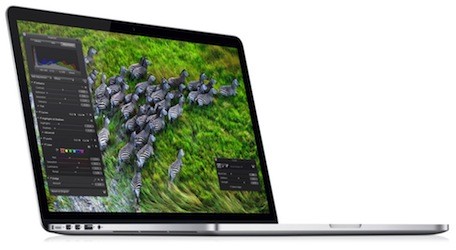
A lawsuit has been filed in federal court in California alleging that Apple is misleading consumers by not advertising that there are two different types of displays used in its MacBook Pros with Retina displays. The issue stems from widespread reports that MacBook Pros with Retina displays that use display panels from LG suffer from ghosting issues. MacBook Pros that use Retina displays from Samsung reportedly are not affected by the same issues.

ArsTechnica reports that the class action lawsuit says that because the two makes of the Retina displays "exhibit different levels of performance and quality" Apple is wrongly marketing the MacBook Pro with Retina display as one product when instead it should be marketed as two different products -- the difference being which display, LG or Samsung, is used in the laptop.

[Source: TUAW]

Smaller A5 Chip From Tweaked Apple TV Contains Only One CPU Core, Revamped Analog Circuitry

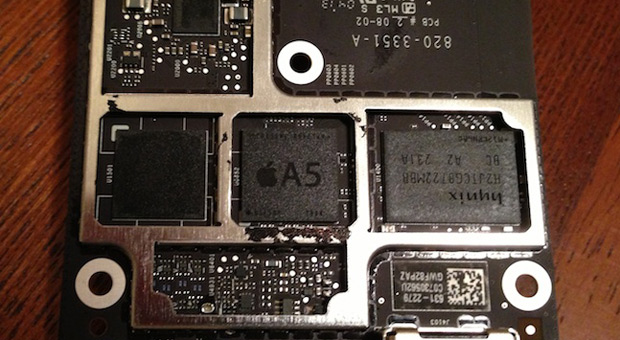
For the past few days, we've been following the story of the smaller A5 chip found inside of the recently tweaked Apple TV, seeking to understand what changes Apple has made in order to shrink the chip to roughly half the size of the previous A5 chip. 

Yesterday, experts at Chipworks determined that the new A5 was still being manufactured by Samsung using the same 32-nanometer process used for the previous version, indicating that Apple had undertaken significant design changes for the chip. 

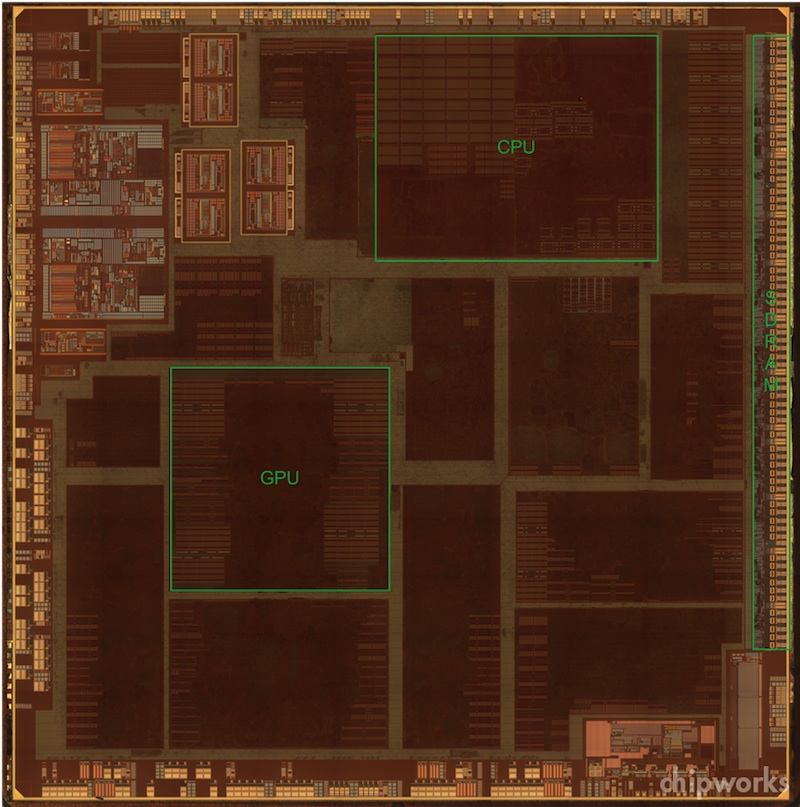
Chipworks now has a full image of the A5 die, revealing that this smaller A5 chip contains only a single-core ARM CPU. Apple has listed the Apple TV as having a single-core A5 since the third-generation model launched last year, but the previous design involved a dual-core chip with one core disabled, while the new design contains just the one active core. The new A5 does still contain the same dual-core GPU found in the previous version of the chip.

Chipworks' Dick James tells us, however, that there must be more to the story in order to achieve a nearly 50% size reduction, but the firm has yet to determine exactly what other changes are contributing to the smaller die size. 

A separate observation of interest involves the analog circuitry included on the chip. This new A5 chip appears to take advantage of optimized analog components such as resistors, capacitors, and inductors, yielding a mixed signal chip that seems to be a rather significant technical achievement at the 32-nanometer process node.

My guess is that the analog sections have been re-designed, always a work in progress when we get this small, since analog circuitry does not shrink anywhere near as predictably as digital. And as Jim said earlier, we think this is now in a mixed-signal version of the 32-nm process that allows extra passive components such as resistors, capacitors, and inductors, that is much more suited to analog stuff.

It is still unclear exactly why Apple has elected to redesign the A5 for the Apple TV, as it has been assumed that the company's "hobby" does not generate enough shipment volume to warrant such an investment in and of itself. As a result, it is possible that Apple has plans to use this chip in other products, although the single-core nature of the CPU design will likely limit the range of devices for which it would be suitable.

[Source: MacRumors]


Phil Schiller Goes on Offensive Against Android and Samsung

Apple marketing chief Phil Schiller went on the offensive against Android in a unusually forthright interview with The Wall Street Journal.

Mr. Schiller, Apple's senior vice president of world-wide marketing, also said that Android users are often running old operating systems and that the fragmentation in the Android world was "plain and simple."

He added that "Android is often given a free replacement for a feature phone and the experience isn't as good as an iPhone."

In addition to the above comments, Schiller saidthat Android devices and the operating system "don't work seamlessly together" because they come from different vendors, unlike Apple which makes both the software and hardware in its devices.

Samsung is expected to announce an update to its flagship Galaxy S smartphone line tomorrow.

[Source: MacRumors]


Google Now for iOS? Promo video appears, removed

Users of Android's recent editions have been exposed to Google Now, the "before you know you need it" search tool.

Google Now tries to look ahead at your schedule and physical location to let you quickly access the most relevant results -- traffic for your commute, flight schedules for your trips, local restaurant recommendations and the like. G-Now uses a card metaphor to pop the necessary info right onto your device screen with minimal intervention.

While Siri can handle quite a few of those search chores on iOS, she's not exactly the anticipatory type. SRI's recent Tempo calendar app gives you some of the same halo of savvy around your schedule, but you have to get cleared first (Tempo still has a waiting list several thousand users long).Google's own Field Trip app delivers location-based tidbits (local art, attractions, restaurants and more) as you move around, but it's not integrated into the main search tool.

There may be changes afoot. Engadget unearthed a promotional animated clip that seems to preview a version of Google Now for iOS; the original video appeared on YouTube and has since been removed. In style, content and narration the clip is entirely in line with Google's original promo for the Android launch of Google Now, which lends quite a bit of weight on the authentic side of the scale.

[Source: TUAW - Click here to read the full story]

iPhone prototype is the size of an iPad

Let's jump into the time tunnel and head back to 2005, where we find this beast: an iPhone prototype the size of an iPad.

This early iPhone prototype was 5 inches wide and 7 inches tall, measuring a chunky 2 inches thick. A mystery Apple employee reveals the device in photos shown to Ars Technica.

The prototype was never designed to bear any relation to a finished design, rather it was a platform to test the technology. So we shouldn't read too much into the fact that it had a whole mess of ports: including an Ethernet port, a serial port and several USB ports, all of which were there to help developers work on the device rather than because Apple thought the finished product should have lots of sockets.

That said, the processor does show that Apple had an idea of what the chip would be like in the finalised phone: the prototype's 233MHz Samsung ARM9 chip evolved into an ARM11 chip in the model that hit shops.

When the iPhone was still just a twinkle in Steve Jobs' and Jony Ive's eyes, potential names considered include 'Telepod', 'Tripad' or 'Mobi' -- or confusingly, the 'Tripod'.

Later prototypes have also emerged, looking more like a phone but still a long way from the iPhone we know, with squared corners and small touchscreens.

[Source: CNET]

Apple suppliers had a very tough February

February is usually not a great month for the companies that supply Apple with its iOS and Mac device parts (Chinese New Year usually falls right in that month, and production in China always take a big downturn as people celebrate there). But this particular past February was especially bad, according to reports: Topeka Capital Markets analyst Brian White says that the suppliers for Apple that he tracks saw their sales data fall 31 percent over the past month, as compared to the usual 8 percent drop in past years. That makes for the worst February on record for Apple's suppliers, which may or may not soon have an impact on Apple.

Now, with Apple's suppliers showing low sales data, that could mean more opportunity for Apple to step in with its big pile of cash and make sure that it has more components than ever to build new devices with, so it's not entirely clear that this will be a bad thing for the company from Cupertino. But of course Apple depends on these suppliers, and if they suffer increased economic pressure for any reason, Apple could experience consequences for its own business.

[Source: TUAW]

Apple’s eBay store offers significantly better deals on Apple.com refurbs

9to5Mac first broke the news that Apple sold refurbished merchandise through its own eBay store last year, equipped with the same price tags, full warranties, and approved inspections, and now the company has dropped prices on many of those items below what it offers at store.apple.com.

9to5Toys and eventually Dealnews recently noticed a $100 price cut for Apple’s 13-inch MacBook Air with 1.8GHz i5 and 128GB of storage (now over). It costs $100 more at store.apple.com for the same refurbished unit.

An even better eBay deal has emerged today: Apple’s 11.6-inch MacBook Air with 1.8GHz, 4GB SDRAM and 256GB SSD is only $949. It’s certified refurbished unite, while the same refurb model goes for $1,059 on Apple.com, and the 256GB MacBook Airs start at $1,299 new. All items come with free standard shipping, and eBay adds sales tax for only a few states at purchase and allows folks to pay with PayPal and BillMeLater.

[Source: 9to5Mac - Click here to read the full story]

Latest Apple TV reveals smaller A5 chip, adds to rumors of split with Samsung

Quiet, mid-cycle component upgrades are a thing with Apple, and they're sometimes worth watching out for. The iPad 2 got a chip update last year, for example, which significantly extended its battery life by using a 32nm A5 SoC instead of a 45nm one. Well, much as expected, a very similar processor update has just come to the Apple TV. MacRumors popped open the latest version, known as "AppleTV3,2", and found good evidence of a further die shrink: the central block of silicon is just 6 mm x 6 mm, which is even smaller than the 8 mm x 8 mm chip in the newest iPad 2. This inevitably leads to speculation that Apple has shifted to a 28nm fabrication process, possibly snubbing Samsung's 32nm foundries, but we'd need a proper silicon-level analysis to be certain. In the meantime, though, we'd guess that this update may not be worth hunting down to the degree that the new iPad 2 was -- the level of shrinkage here doesn't seem enough to have a huge impact on power draw, and in any case that's less of an issue for a device that's fed from the wall.

[Source: Engadget]

Philips Releases Open APIs and SDK for iOS Controlled Hue Lighting System

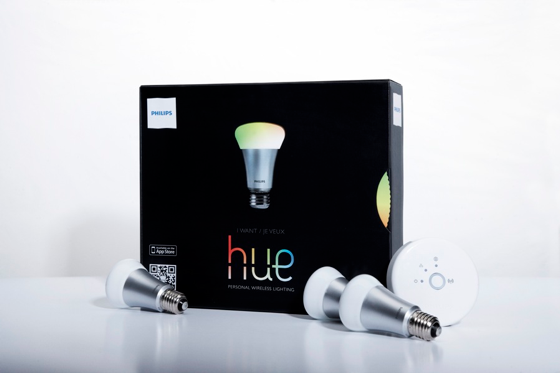
TechCrunch reports that Philips has created an official developer program for its Wi-Fi connected Hue home lighting system, which includes an SDK for iOS and APIs to allow hardware and software developers to integrate Hue into their products. 


Hue, which is exclusive to iOS, allows users to control LED lightbulbs via the iPhone and an accompanying bridge that uses the ZigBee communication protocol. 

"We're now at a point where there are already about 10 applications that have been shared and built from the unofficial developer community for new applications around Hue," explained George Yianni, Hue System Architect in an interview. "Now what we want to do as Philips is we actually want to help and grow and encourage this community, and give them tools and proper documentation. Also, we want to give them commitment that this is the API and we’re going to support it and it won’t change overnight."

Though Hue-integr additional ated third party apps such as last week’s Ambify have been released, these solutions do not use official APIs. According to Yianni, the unavailability of official APIs is the main reason that the Hue has yet to be integrated into apps and connected home devices. 

The new Hue tools are freely available for all developers interested in creating a product or an app that connects to the system

Philips plans to add additional functionality to the Hue in the future, focusing on geofencing, scheduling, and other sensor capabilities. The company is also working on expanding the Hue line with new lightbulb types.

[Source: MacRumors]

Apple Lawsuit Over Siri With Samsung to Move Forward

California judge has ordered that Apple’s case against Samsung over search patents used in the Siri voice assistant can move forward.

Judge Lucy Koh is once again presiding over a lawsuit between Apple and Samsung. This is the same judge who has been presiding over the case where Apple won a billion dollar settlement, but it’s doubtful she is happy to see the two companies in her courtroom yet again as in Dec. of last year she told them she was not “joking” and it was time for “peace” between the two firms.

The latest case is a separate matter from the other trial and deal with Apple suing Samsung over violation of patents in regards to search functionality in Siri. According to Reuters, Judge Koh tried to convince the two companies to delay the case until the appeal in the other one is settled, but neither was interested in that course of action. Koh has now ruled the case can move forward with a March 2014 trial date, but she has asked both companies to cut down on the number of issues and expert witnesses both want to address in an attempt to ”significantly” streamline the case. If that sounds familiar, it’s because she asked them to do the same in the other case in Feb.

It is doubtful either company is going to want to cut the case very much, but this is the same Judge that last year told Apple’s lawyers that they were “smoking crack,” so we’re pretty sure she will be telling them again how she expects this to move forward.

[Source: TechnoBuffalo]

iBooks 3.1 brings paid content to iBookstore in Japan

Version 3.1 of iBooks is out today and while it might not bring much in the way of new features for Western users, it's a pretty big deal for book lovers located in Japan. That's because the latest update introduces paid content on the order of hundred of thousands of books -- encompassing novels, manga and more -- something that the country's iBookstore has been without up until this point. Before now, iOS users in Japan have needed to be content with public domain e-books.

In addition to the paid content rollout, the 3.1 update also introduces some improvements when reading Asian language books.

[Source: TUAW]