Steve Jobs Didn't Want an iBookstore, but the iPad and Eddy Cue Changed His Mind

Testifying in court yesterday as part of the ongoing e-books price fixing trial, Apple senior vice president for Internet Software and Services Eddy Cue offered some perspective on the history of iBooks and the iBookstore, noting that Steve Jobs was initially opposed to such a project. As shared by AllThingsD, Cue noted that it wasn't until just prior to the launch of the iPad that he was able to convince Jobs of the potential of e-books.

“… When I got my first chance to touch the iPad, I became completely convinced that this was a huge opportunity for us to build the best e-reader that the market had ever seen,” Cue said. “And so I went to Steve and told him why I thought [the iPad] was going to be a great device for ebooks. … and after some discussions he came back and said, you know, I think you’re right. I think this is great, and then he started coming up with ideas himself about what he wanted to do with it and how it would be even better as a reader and store.”

Cue had initially suggested an e-book effort earlier in the fall of 2009, but Jobs felt that the iPhone's screen was too small to allow for a good user experience and that the Mac didn't feel like a reading device. By the time Jobs was on board, it was November, and the iPad was scheduled for a January introduction, giving Cue just weeks to line up the deals needed to build the iBookstore. 

In relating the story, Cue noted that getting the iBookstore deals done took on special significance for him, as it was obvious that Jobs was in declining health at the time. Jobs had taken a strong interest in iBooks for iPad, and was committed to showing it off at the iPad media event, giving Cue extra incentive to make sure everything was in place.

Source: Mac Rumours

Apple Allowed Developers to Test a Prerelease Mac Pro Hidden Inside a Metal Box

Before Phil Schiller gave the world a sneak peek of the new Mac Pro at WWDC this week, Apple allowed select developers to come to its Cupertino headquarters to test out their software on preproduction hardware.

AppleInsider spoke with employees of The Foundry, a firm that develops high end rendering software used on Hollywood productions.

The Foundry shared with AppleInsider the story of how its team worked with the new Mac Pro in a room at Apple HQ known as the "Evil Lab" ahead of the desktop's unveiling. During the tests, the Mac Pro was entirely concealed in a giant steel cabinet, keeping its new design a mystery to The Foundry and Pixar.

"We were essentially doing a blind tasting of the machine," said Jack Greasley, MARI product manager at The Foundry. "All we could see was the monitor, and the Mac Pro was encased in a giant metal filing cabinet on wheels. Experiencing the machine in this way was actually really cool, because I can tell you that the speed and power of this machine really stands up. Mari running on this machine out of the box is the fastest I have ever seen it run."

Greasley said "some real innovation and thought has gone into what users want and need" with the new Mac Pro, and he doesn't "think pro users should be concerned" about the new machine.

Representatives from The Foundry and Pixar participated in a lunchtime session at WWDC this week, demonstrating the company's MARI software running on the new Mac Pro. The company managed to get a working copy of MARI ported to the Mac in just under a week and convinced Apple executives to give a significant block of time at WWDC to demo the software and the new machine.

The Mac Pro is expected to be released later this year.

Source: Mac Rumours

iOS 7 looks great, but can it lure this Android user?

iOS 7 is still not quite the Droid I've been looking for in an iPhone.

I've been an Android devotee for about three years now, but ever since the introduction of theiPhone 4S and Siri -- something totally new running on a nice piece of hardware -- I've been considering making the switch to iOS. As intriguing and enticing as the 4S was, I balked due to the lack of LTE. The iPhone 5 fixed that, but by then iOS seemed stale to me, and the lack of any major new innovations kept me tapping away on my aging Droid Razr and led me to declare that the iPhone and the ascendant Apple of this century's first decade had peaked. (Actually, the phrase I used was "jumped the shark" -- I suggest reading the original post for an explanation.)

So I watched with great interest on Monday as Apple unveiled a reboot to its mobile operating system in the form of iOS 7, which is being hailed as beautiful and ambitious. CNET editors have dubbed it a "radical new look" and part of Apple's "quest for perfection and the devotion to creating objects of profound and enduring beauty," as our Dan Farber put it...

Read the full story here. Source: CNET


As Apple reorients its Maps, Google forges ahead

Apple blew it big-time last year with the botched launch of its own Maps. At its Worldwide Developers Conference on Monday, the company tried to show that it knows which direction to take Apple Maps.

We won't how know well it works until the fall. But Google -- the leader in online maps -- isn't waiting around.

Google's purchase of Waze -- a deal that Google confirms Tuesday but won't elaborate on -- will, if nothing else, keep a rival from snapping up the hot Israeli startup.

Google reportedly spent more than a literal ton of cash to buy the crowd-sourced traffic mapping company. The price, reportedly more than $1 billion, is no small sum for a company that does much of what Google Maps already does.

What Google is buying
While Google is the undisputed leader in the field, said electronic maps expert Marc Prioleau, Waze comes with three key assets. The app itself, which handles features like social interaction and route mapping; the map database, which contains all the location information; and, said Prioleau, "a really good team of 100 people..."

Read the full story here. Source: CNET


iOS 7 Beta Tidbits: Per-App Cellular Data Usage, Live Clock Icon, Panoramic Wallpaper and More

While the most obvious change in iOS 7 is the look and feel of the user interface, Apple's engineers have packed the update with numerous changes both big and small. 

Here are a selection of changes noticed by folks in the MacRumors Forums and elsewhere. 

Cellular Data Tracking by App - In Settings / Cellular, users can track cellular data usage on a per-app basis. Apps can have their cellular data access disabled individually as well. 

Update Apps Manually - The App Store now updates apps automatically, but for users who prefer to handle things themselves, automatic updates can be disabled via a slider in Settings / iTunes & App Stores. 

How to Get to Spotlight - Spotlight is now accessible from the home screen by swiping down from the middle of the screen. Additionally, in Settings / General / Spotlight Search, users can manually turn search result categories on and off, as well as change the order results are presented in. 

Live Clock Icon - The clock icon provides the correct time, including a live second hand. The weather app does not update -- it is always partly cloudy. 

Newsstand Has Permanent Icon - Newsstand's icon remains the same regardless of what publications are inside it. The app itself works similarly, though the design is substantially different. Newsstand can now be put inside a folder as well. 

App Permission for Microphone Access - Apps are now required to ask permission to access the microphone, similar to how apps currently ask to access location data or the camera. 

Multitasking Switcher Works in Landscape - The app switcher works in landscape mode. Double-tap the home button to access. Control Center can also be used in landscape. Apps can also be manually quit by swiping up, and multiple apps can be closed at the same time...

Read the full story here. Source: Mac Rumours


Apple Announces iTunes Radio, Ad-Supported, Free for iTunes Match Subscribers

Apple announced iTunes Radio today, a new internet radio service that is built into theMusic app in iOS 7. The new feature offers music discovery through featured and genre stations provided by Apple or through the creation of new stations based on a specific artist or song.

 "iTunes Radio is an incredible way to listen to personalized radio stations which have been created just for you,” said Eddy Cue, Apple’s senior vice president of Internet Software and Services. “It’s the music you love most and the music you’re going to love, and you can easily buy it from the iTunes Store with just one click.

iTunes Radio keeps track of all of the songs listened to for easy access later for purchasing or repeat listening. iTunes Radio will also be available on Mac and PC through iTunes and Apple TV. 

iTunes Radio will be available in the fall for free with ads while iTunes Match subscribers get an ad-free experience. The service will be available starting in the US only at first.

Source: Mac Rumours


Apple Announces OS X 'Mavericks'

At today's WWDC keynote event, Apple announced the next version of its Mac operating system, dubbed "Mavericks" after a surfing area north of Half Moon Bay in California. Mavericks will feature many new Finder features including tabs, full-screen capability, tagging, and independent handling of multiple displays. 

Tagging items allows users to categorize and search for files more easily. With multiple displays, Finder will display a menu bar in each to allow easier control of all apps. Mission Control has also been modified to allow easy transfer of apps between displays, and Mavericks can display apps through a connected Apple TV. 

A new feature called Timer Coalescing will reduce CPU activity by smoothing out active processes and idle time while another new feature, Compressed Memory, will compress inactive memory to make free space available to running apps. 

Safari gets a revised Top Sites page and a sidebar with direct bookmark and Reading List access. Also visible in the sidebar are links shared by friends through social networks. The browser's memory and energy usage has also been improved in Mavericks. 

Keychain moves to iCloud in Mavericks to enable cross-device synchronization of passwords for use within Safari and other apps. Keychain will be able to suggest strong passwords and will remember credit card information to make online shopping easier. 

Notifications also get an overhaul with the ability to respond to iMessages or even decline Facetime calls right from the notification banner. After waking from sleep, notification banners for alerts received during sleep will appear on the lock screen. 

Maps app will come to the Mac in Mavericks, offering search capabilities, Flyover views, turn-by-turn directions and the ability to send directions directly to an iOS device. 

iBooks is coming to the Mac as well, with direct access to content available in the iTunes Store. Reading features include bookmarks, a night mode, and access to embedded multimedia elements. 

Registered developers can preview Mavericks starting today and the final public release of the OS is planned for the fall.

Source: Mac Rumours

Apple Announces New MacBook Airs with Haswell Processors and 'All-Day' Battery Life

At today's WWDC keynote in San Francisco, California, Apple announced new 11-inch and 13-inch MacBook Airs, which have been designed with battery life in mind. As expected, the new Airs use Haswell processors that offer enhanced performance and significantly improved battery life, but feature no cosmetic changes. 

With the new Haswell processors, The 11" MacBook Air will now have nine hours of battery life while the 13" MacBook Air will have a stunning 12 hours of battery life.

In addition to Haswell processors, the new MacBooks feature 802.11ac compatibility, with support for the "Gigabit WiFi" 802.11ac specification. Gigabit WiFi offers speeds up to three times as fast as existing 802.11n wireless networks. 

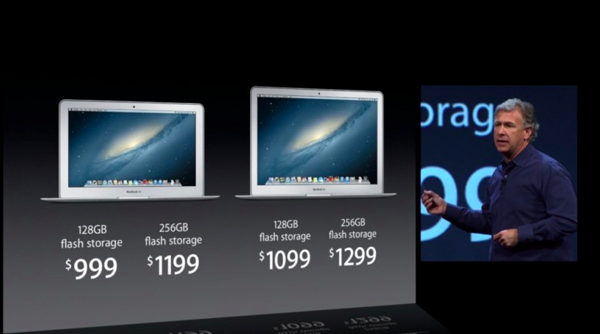
The 11" MacBook Air starts at $999 with a 128GB hard drive and the 13" MacBook Air with a 128GB hard drive starts at $1099. Apple's MacBook Airs are available today from Apple's Online Store and at retail locations.

Source: Mac Rumours


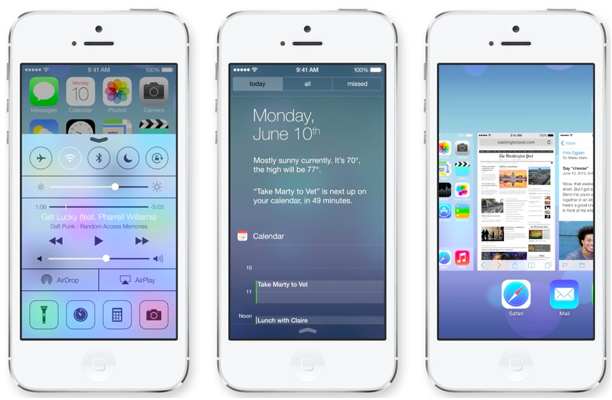
Apple Unveils iOS 7 with Major Design Overhaul, Multitasking and Control Center

At today's Worldwide Developers Conference in San Francisco, Apple unveiled the latest iteration of its mobile operating system. As expected, iOS 7 features a major design overhaul that removes many of the skeuomorphic elements found in previous versions of iOS, instead favoring a clean and gloss-less "flat" look. 

"It's the biggest change to iOS since the introduction of the iPhone," said Tim Cook. "It has a whole new structure that is coherent and that is applied across the entire system," said Jony Ive in a video showing off the new operating system. "We've considered the tiniest details like refining the typography to much larger ones like redesigning all the icons..."

Read the full story here. Source: Mac Rumours


Apple Tease with New Mac Pro Coming

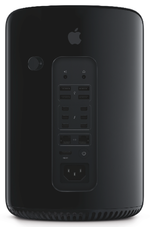
Today, Apple Inc gave us details of their new Mac Pro coming later this year. The radical new redesign sees many new features including a cylindrical form-factor, next gen Xeon processors, memory with 60GBps bandwidth and all PCIe flash based storage. In addition to these new performance winners, we also get some little design touches, like the built in handle and a back panel that lights up "tron style" to show us the ports. No pricing yet, with later this year not coming soon enough. Full details here.

Wave-Themed OS X Banner Goes Up at Moscone West for WWDC 2013

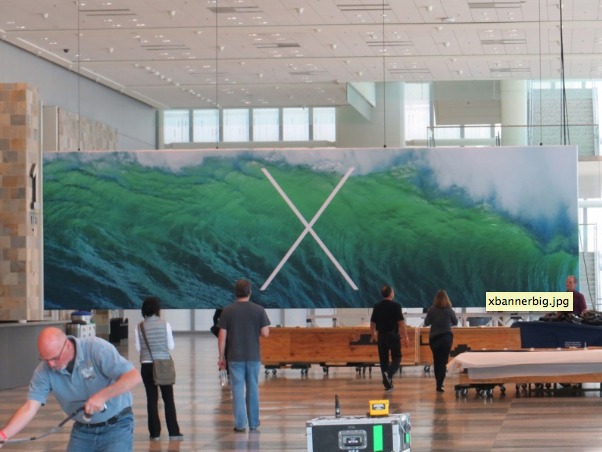
9to5Mac has posted a new photograph showing a wave-themed banner with an X in the middle, similar to the iOS 7 banner that was revealed earlier today. The spartan and minimalistic banners are significant change from the style used in previous years, particularly the OS X banner below.

The X appears to use the Helvetica Neue Ultra Light font, an extremely thin variant of Helvetica and the same font as the iOS 7 banner.

Source: Mac Rumours 

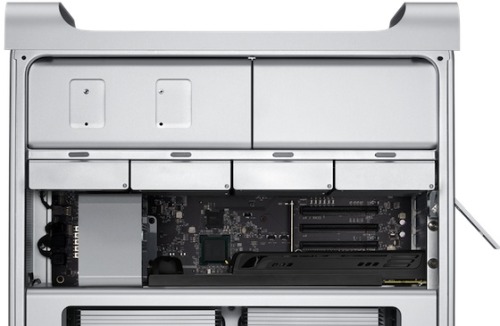
Apple Planning 'Something Really Different' for New Mac Pro

The new Mac Pro model, expected later this year, is "something really different" according to a video professional who says he spoke with the Mac Pro product manager.

Writing on the RedUser.net forum, Andrew Baird says he spoke to Mac Pro project manager Douglas Brooks on the phone after emailing CEO Tim Cook with his concerns about the lack of a new professional tower from Apple over the past few years.

Baird told MacRumors that the call didn't include any specific details about when the new machine would be released, nor its specifications -- however, he was assured several times that the new Mac Pro would be worth the wait. Brooks told him that the machine would be released later this year.

Somewhat corroborating Baird's phone call, Lou Borella -- administrator of the 'We Want a New Macpro' Facebook group -- wrote on the page that he heard the new professional Mac would be "heavily reliant on Thunderbolt" with "no internal expandability", and would have support for dual-GPU's and no FireWire or optical drive.

In mid-2012, after a minor update to the Mac Pro was announced at WWDC, Tim Cook confirmed to a fan that new Mac Pros were coming in 2013, which was later reiterated by an Apple spokesman. It has also been rumored that the new Mac Pro would be the first Apple computer in years to be 'Made in the USA'

Source: Mac Rumours