Over Two Billion iMessages Are Sent Every 24 Hours

Here’s another humungo stat Apple dropped during its earnings call on Wednesday: two billion iMessages are sent every single day. So over the course of a year, 730 billion iMessages are sent between iOS users—every Mac, iPhone, iPad, and iPod touch. Holy Buffalo.

Apple didn’t quite meet expectations this quarter, but that didn’t stop the company from breaking records. In addition to the impressive iMessage stat, Apple also revealed that it has sold over 500 million iOS devices, with 250 million iCloud activations up to this point. Not too shabby at all.

[Source: TechniBuffalo]

Apple TV Sells 2 Million Units in the Holiday Quarter; Still a Hobby

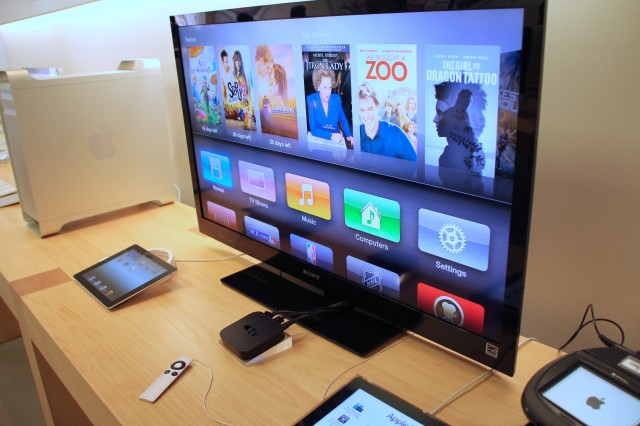
Apple reported today that the Apple TV streaming device sold 2 million units during the holiday quarter. When exactly will this finally qualify as a real product?

Last quarter Apple sold 1.3 million Apple TV units, and during the 2011 holiday quarter it sold 1.4 million. The 2 million it sold in this latest quarter represents a 60 percent increase, and makes it one of the top selling streaming solutions on the market. Somehow Apple still feels this product qualifies as a “hobby,” much to the confusion of folks who work in the tech industry.

Most companies would be ecstatic if its product sold 2 million units in a quarter, and a large number of them could make that the only thing they do. In the case of Apple, somehow it remains a “hobby,” a product that is not considered serious enough to be included in quarterly reports, but still gets asked about on the earnings call.

At some point Apple will have to admit this is a real product, but one has to wonder what the magical sales number is to trigger that event.

[Source: TechnoBuffalo]

Mac sales fall, but iPhone and iPad keep Apple cash coming

Apple's line of Mac computers aren't selling as well as they were a year ago -- though a tumble in sales figures hasn't stopped Tim Cook and co. from earning a record amount of cash.

Divulging its earnings for the last three months of 2012, Apple revealed that it had flogged 4.1 million Macs, compared with 5.2 million in the same period the previous year.

Apple blames manufacturing constraints on its new, much thinner iMac desktop (pictured above), which may have impeded the maker of shiny gadget's ability to rake in Mac cash.

Apple isn't sure it will meet iMac demand in the first part of 2013 either, tuaw.com reports, with Tim Cook quoted as saying in an earnings call, "We're confident that we're going to significantly increase the supply, but the demand here is very strong and we are not certain that we'll achieve a supply/demand balance during the quarter."

The number of iPods sold has also dropped from 15.4 million in the last quarter of 2011, to 12.7 million in the same period last year.

Despite not every product line making Apple as much money as it has previously, the iPod-maker still posted record-busting revenue of $54.5 billion (about £34.4bn), and an eye-watering $13.1bn (roughly £8.3bn) of profit.

By comparison, Android-owner Google cleared $2.89bn (about £1.82bn) of profit in the same three months of last year, proving that when it comes to generating terrifying stacks of moolah, Apple still rules the roost.

It's earning power is down largely to the steady popularity of its mobile gadgets. Apple flogged a whopping 47.8 million iPhones in the last quarter of 2012, compared to 37 million in the same period in 2011, and 22.9 million iPads, compared with 15.4 million in the prior year. Samsung recently boasted that it had flogged 40 million Galaxy S3 units to retailers since its flagship phone went on sale six months ago.

Wall Street shuffle

Apple made $4.2bn per week in the last three months of 2012, but it wasn't enough to impress investors, who expected even greater numbers from the company. Amid concerns that Apple has lost its way, following the publication of the results nearly $47bn was wiped off the company's stock-market value.

I don't think it's unfair to say that Apple's last few product announcements have felt a tad underwhelming, but then it's hard to imagine where Apple could go with devices like the iPhone and iPad. Fingers crossed we see an exotic new product this year. Perhaps that TV everyone's been harping on about, or a car perhaps?

[Source: CNET]

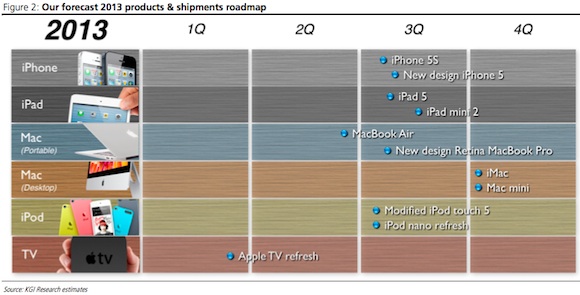
Apple's 2013 Product Roadmap Predictions: Multiple iPhones, Retina iPad Mini, All-Retina MacBook Pros

KGI Securities analyst Ming-Chi Kuo, who has a very good track record in predicting Apple's product plans, has issued a new research report outlining his expectations for Apple's 2013 product launches. Kuo believes that Apple will focus its launches on the third quarter of this year, with a number of updates throughout the company's various product families.

[Source: MacRumors - Click here to read the full story]

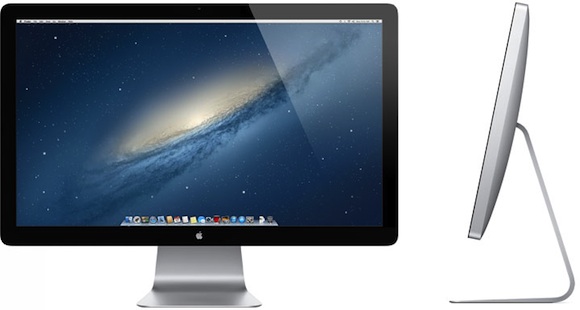
Apple Thunderbolt Display Supplies Begin Running Short at Third-Party Resellers

One of the most significant changes likely to make an appearance in a redesigned Apple Thunderbolt Display is the adoption of the thinner profile and new display assembly process seen in the company's latest iMac. The current Apple Thunderbolt Display borrows heavily from the previous generations of the 27-inch iMac, and thus it seems reasonable to assume that some of the iMac design changes such as new lamination procedures to make the display thinner and more vibrant will make their way to the standalone display. 

But with that lamination process leading to shortages of the 27-inch displays used in the iMacs, an issue expected to persist until next month, Apple may hold off on introducing a new standalone display for the time being in order to prioritize the iMac. 

Other changes likely to appear in an updated display are a move to USB 3.0 ports, which have become standard on Mac products, and the inclusion of a MagSafe 2 port for charging Mac notebooks. The current Apple Thunderbolt Display still uses the original MagSafe design for power passthrough, with Apple bundling a MagSafe to MagSafe 2 Converter to provide compatibility for owners of newer Mac notebooks.

[Source: MacRumors]

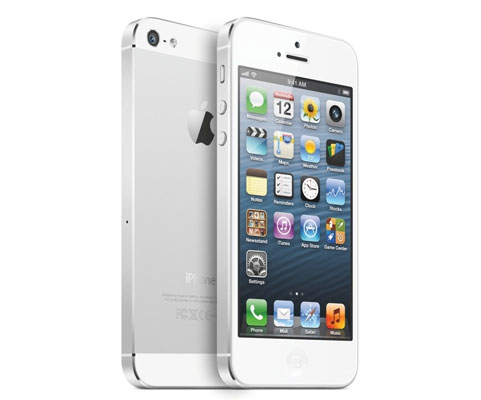
Apple Slashes iPhone 5 Part Orders Due to Weak Demand

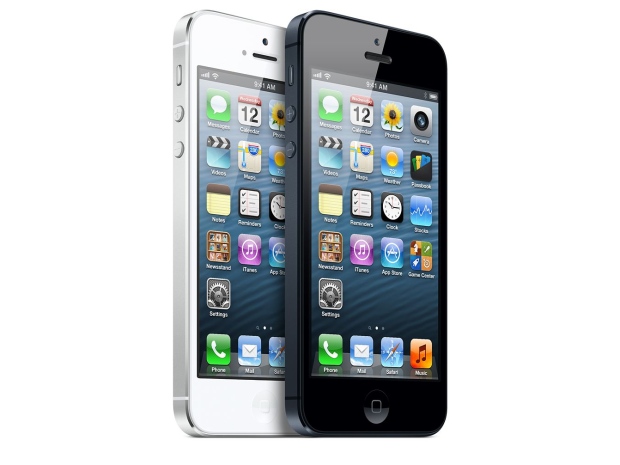
The Wall Street Journal reports that Apple has slashed component orders for the iPhone 5 this quarter, responding to weaker-than-expected demand.

Apple's orders for iPhone 5 screens for the January-March quarter, for example, have dropped to roughly half of what the company had previously planned to order, two of the people said. 

The Cupertino, Calif., company has also cut orders for components other than screens, according to one of the people. 

Apple notified the suppliers of the order cut last month, the people said.

There have been reports that Apple is looking to launch its next-generation iPhone in the middle of this year as part of a broader effort to shorten its product update cycles. Apple is reportedly also toying with other changes such as a cheaper version of the iPhone in order to help the company slow the momentum of Android and its leading manufacturers Samsung.

It is not unusual for demand, and thus Apple's component orders, to wane in the lead-up to hardware updates, but the iPhone 5 is just four months old, and the slashing of production at this stage of the device's lifecycle is sure to cause concern for the company, its investors, and others closely watching Apple's performance.

[Source: MacRumors]

Apple Blocks Java 7 Plug-in on OS X to Address Widespread Security Threat

As noted by ZDNet, a major security vulnerability in Java 7 has been discovered, with the vulnerability currently being exploited in the wild by malicious parties. In response to threat, the U.S. Department of Homeland Security has recommended that users disable the Java 7 browser plug-in entirely until a patch is made available by Oracle.

Hackers have discovered a weakness in Java 7 security that could allow the installation of malicious software and malware on machines that could increase the chance of identity theft, or the unauthorized participation in a botnet that could bring down networks or be used to carry out denial-of-service attacks against Web sites. 

"We are currently unaware of a practical solution to this problem," said the DHS' Computer Emergency Readiness Team (CERT) in a post on its Web site on Thursday evening. "This vulnerability is being attacked in the wild, and is reported to be incorporated into exploit kits. Exploit code for this vulnerability is also publicly available."

Apple has, however, apparently already moved quickly to address the issue, disabling the Java 7 plug-in on Macs where it is already installed. Apple has achieved this by updating its "Xprotect.plist" blacklist to require a minimum of an as-yet unreleased 1.7.0_10-b19 version of Java 7. With the current publicly-available version of Java 7 being 1.7.0_10-b18, all systems running Java 7 are failing to pass the check initiated through the anti-malware system built into OS X.

[Source: MacRumors]

Cheap iPhone will 'never be the future of Apple'

Speaking to the Shanghai Evening News, Apple's marketing boss Phil Schiller ruled out the possibility of a cheap phone from the Californian company.

A budget version of the iPhone is heavily rumoured. The iPhone 5S or iPhone mini or whatever it might be called would take on the wide range of Android smart phones that are more affordable than the iPhone. But Schiller points out that despite iPhone sales making up about a fifth of the phone market, "we own 75 per cent of the profit".

A cheaper iPhone would increase the first number, market share, but the lower revenue generated by each sale means the impact on the second number wouldn't necessarily be worth devaluing the brand. Apple has meticulously carved out a premium reputation for its products, and a budget phone could damage that.

That said, Schiller is talking about cheap phones in the sense of phones that lack the quality of pricier blowers. But with the iPad mini, and before it iPod spin-offs like the iPod mini and iPod nano, Apple has a history of making devices that are still of the same high quality but are, whisper it, cheaper. We still won't rule out an iPhone mini completely.

On the other hand, you could argue that we already have a cheaper iPhone: it's called theiPhone 4. And you could argue that we already have an iPhone mini -- it's called the iPod touch.

[Source: CNET]

Apple: 40 Billion Apps Downloaded to Date, Nearly Half of Those in 2012

Apple announced Monday that there have been more than 40 billion app downloads from its iTunes App Store to date.

Surprisingly, nearly half of those downloads were during 2012 alone, which just goes to show the incredible growth that Apple’s store has gone through the past year — especially as new devices, such as the fourth generation iPad, the iPhone 5 and the iPad mini begin to take the market by storm. The popular game Temple Run, for example, has already been downloaded 75 million times since its release.

The iTunes App Store now offers more than 775,000 iPhone apps and 300,000 applications for the iPad.

[Source: TechnoBuffalo]

The Apple Store begins offering Retina 15″ MacBook Pro refurbs starting at $1869

This evening, Apple began offering refurbished Retina MacBook Pros at the online Apple Store at significant 15% discounts, yielding savings of over $500 on high end models (below). 15-inch Retina MacBooks normally retail at $2200 but we’ve seen them as low as $2,000 (which is also the EDU discount price).

Apple refurbished products are packaged and look like new and come with the same one year of AppleCare. See all of the best prices on Apple Products on our Apple product pages.

[Source: 9to5Mac]

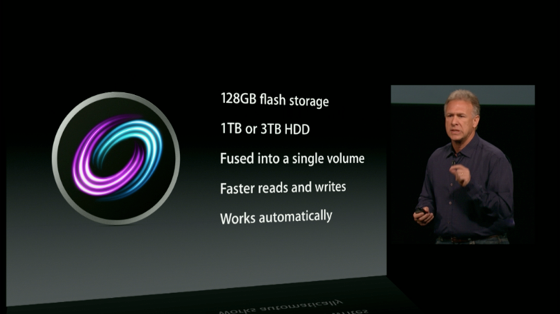
Fusion Drive Now Available as Option for Low End 21.5" iMac

As noted by MacGeneration and in our MacRumors Forums, Apple is now allowing the entry level 21.5" iMac to be configured with a 1TB Fusion Drive. 
The Fusion Drive is a built-to-order option for the iMac and Mac mini that combines SSD and traditional hard drives into a single logical volume.

With Fusion Drive in your iMac, disk-intensive tasks — from booting up to launching apps to importing photos — are faster and more efficient. That’s because frequently used items are kept at the ready on speedy flash storage, while infrequently accessed items go to the hard drive. The file transfers take place in the background, so you won’t even notice.

The 1TB Fusion Drive add-on is a $250 option and was previously only offered on the high end 21.5" iMac, high end Mac mini and 27" iMacs.

[Source: MacRumors]

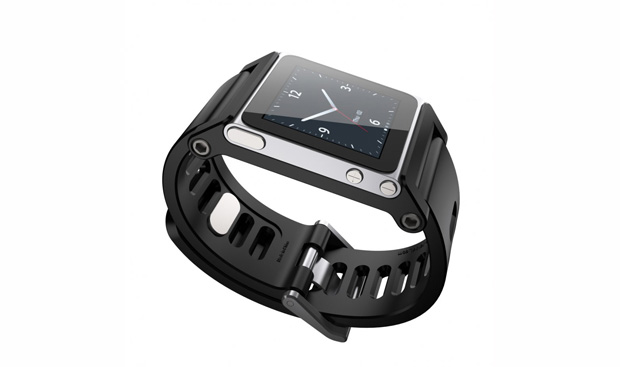
Apple rumoured to be making a smart watch with Intel

Tech-infused watches have been very hit-and-miss over the years. For every Pebble watch gaining plaudits, there's an LG Watchphone that sinks without a trace. While they are becoming more popular, in various guises, none have really become an essential part of our tech get-up.

Well that could change soon, if a rumour from Chinese site Tech 163 (via PocketNow) is to be believed. Because Apple is rumoured to be working with Intel on a smart watch that could go on sale in the first half of 2013. And if Apple gets involved, expect others to up their game, sharpish.

The timepiece is rumoured to have a 1.5-inch OLED screen with indium tin oxide coated glass. It'll run iOS, which is no great surprise.

So could the rumour be true? Despite the many failed attempts, techy timepieces are improving. Sony launched an Android-powered time-teller this year, and devices like the Pebble e-paper watch gained a lot of attention on Kickstarter recently. Nike's Fuelband -- which monitors your activity to keep you fit -- while not strictly a watch, is a wrist-based piece of tech that's been a huge success. Apple's previous iPod nano could be worn as a watch as well -- just slot it into a strap. So we are getting more used to wearing our tech on our wrists.

I think if Apple was to venture into watch territory, it would be more of a 'hobby' product than a huge launch. Maybe as an extension of the old iPod nano, with a few fitness apps to rival Nike's Fuelband. Apple tends to wait until a product area is quite mature before going into it, so it can learn from others, so it could be the time is almost right. But let's wait and see.

[Source: CNET]