iPhone 5S Due in Summer, New iPads in April

There are a bevy of fresh Apple rumors this morning. One of them suggests that Apple will add a fingerprint scanner to its next generation iPhone and that the new device will be introduced alongside a budget iPhone this June or July. A second rumor, also published on Tuesday, suggests that Apple will instead launch the device in August and will refresh its iPads in April.

“We expect Apple will introduce its new iPhones and iOS7 in June, and start shipping the new iPhones (5S and low-cost model) in the FDD version in July,” KGI Securities analyst Ming Chi Kuo said in an investor note. “Both dates are earlier than last year’s roadmap. We attribute this to: (1) an effort to avoid repeating the fatal mistake of last year of the delayed iPhone 5 launch, which gave competitors room to grab market share; and (2) the new iPhones this year are mainly designed on the basis of the current iPhone 5, which suggests development time could be reduced.”
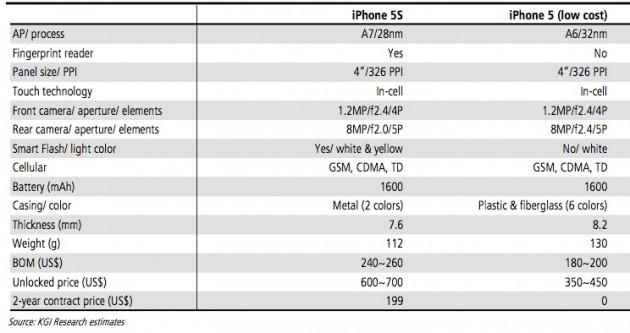
Kuo said he believes the iPhone 5S will run on a faster A7 processor and will offer a new “smart flash” technology for better photos. There will also allegedly be a fingerprint scanner built into the home button to increase security. He also argues that Apple’s highly rumored low-cost iPhone, which other rumors have suggested was delayed until next year, will be crafted out of fiberglass and plastic and will be sold in several different colors at the same time as the iPhone 5S.

Rene Ritchie from iMore is in agreement that the iPhone 5S be thinner and will pack a more powerful processor and better optics than the iPhone 5, but said that it will launch in August instead of June/July. Ritchie also said Apple is gearing up to launch its iPad Mini 2 and an iPad 5 sometime in April.

[Source: TechnoBuffalo]
Jony Ive Ordered Boxes Full of Nike Watches in the Mid-2000s

Bloomberg today published a story on the much rumored Apple smart watch, offering information on potential functionality and profitability. The article also hinted at possible design cues for the iWatch, highlighting Apple designer Jony Ive's intense interest in watches, specifically those manufactured by Nike in the mid-2000s. 

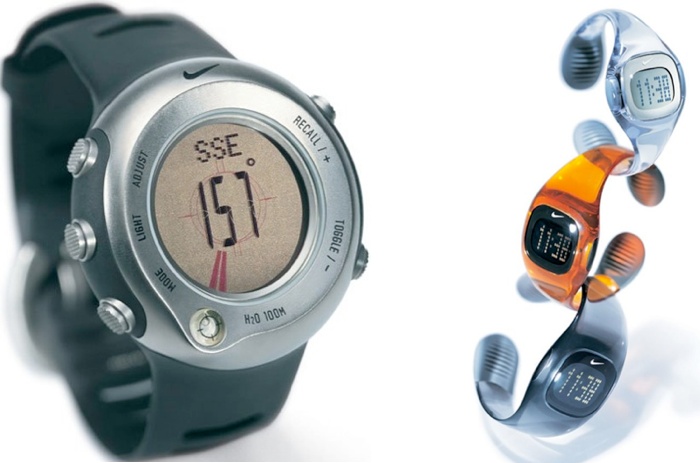
Apple design chief Jony Ive has long had an interest in watches. Besides owning many high-end models himself, he had his team visit watch factories and ordered boxes of a sports watch made by Nike Inc. in the mid-2000s, said Wilson, who was then Nike's creative director.

New information from Business Insider reveals that Scott Wilson sent Jony Ive the Nike Presto Digital Bracelets and the Oregon Series Alti-Compass watches, which were manufactured in 2002–2004. 

Both of these watches feature clean, simple designs. The Presto Digital Bracelet is a cuff-style wraparound watch with a translucent plastic body, while the Oregon Series Alti-Compass has an aluminum face.

Well, he didn't buy them. We just gave them to them as designer bro deals. He and others in the design group just requested them and we sent them a ton of Nike Presto Digital Bracelets and the aluminum Oregon Series Alti-Compass watches. Was flattered that they were requesting them.

Wilson goes on to say that after receiving the watches, Apple asked questions about materials and processes.

This meshes up with their research in watch manufacturing during that timeframe which has been documented in previous stories. They definitely drew upon watch industry techniques and manufacturing in their products since the first iPhone. Interesting that it may come full circle to an actual iWatch at some point.

A patent application found last week suggested that Apple might be looking at a watch with a wraparound design, a touchscreen, and a flexible glass display, but it remains unclear what the actual watch might look like. 

Apple is said to have a team of 100 product designers working on the watch. The watch isrumored to run the full version of iOS and though a release date remains unclear,Bloomberg has suggested that it could launch as early as 2013.

[Source: MacRumors]

WSJ: Apple's App Store climbs towards $25 billion in sales

The Wall Street Journal has posted an article covering the meteoric rise of the App Store, from its inception just a few years ago to its current state of almost $25 billion in annual sales. But while the App Store is growing like crazy, it's also presenting more problems for developers as well: Finding a significant crowd of customers is getting tougher and tougher, and just making a name for yourself in such a huge market isn't always easy.

And it doesn't help that customers are flying through apps extremely quickly. Mobile analytics firm Flurry tells the WSJ that while users do now spend about two hours a day on apps, the apps they use don't stick around for very long. About 63% of the apps in use today weren't used daily a year ago, and most customers focus on about eight apps at a time, according to the research. That makes sense: In such a huge market, with so many apps to try, why focus on just a few?

But it also means that the app market is going to have to mature. The WSJ cites ESPN for shuttering one of its apps while focusing on the more popular Scorecenter utility, and they also mention Shazam, an app that has found all sorts of functionality (and more revenue streams) as it has matured in the App Store. Apple's App Store marketplace has gone from zero to billions in just the past few years, and no one's got an exact road map for where it's headed next.

[Source: TUAW]

iOS 6.1 Evasi0n Jailbreak Now Installed on More Than 14M Devices

The iOS 6.1 evasi0n jailbreak that was launched exactly a month ago is already installed on more than 14 million devices, a member of the team that created the tool said recently. The jailbreak works on the iPad, iPod touch and the iPhone and works on both iOS 6 and iOS 6.1 devices, so not every one of the 14 million devices is an iPhone, but it’s stunning just how quickly iOS users wanted to use the tool.

Jailbreaking serves a number of purposes, but one of the most sought after experiences is the Cydia app store that has thousands of unique applications that aren’t available from iTunes. You can install apps that make it easier to control your settings panel with an easy swipe, for example, and other tools provide more control over the look and feel of iOS than Apple offers.

Jailbreaking also makes it possible to install cracked versions without paying for them. Perhaps this is a sign that Apple needs to provide more control over iOS devices from the get-go, however. Clearly the people have spoken.

[Source: TechnoBuffalo]

Apple: More Than 8 Million iPads Sold to Educational Institutions

Apple announced last week that there have been more than 1 billion iTunes U downloads across 1,200 universities and 1,200 K-12 schools. The company also confirmed to TechCrunch in a separate statement that it has sold more than 8 million iPads to schools and other educational facilities around the globe. According to AllThingsD, more than half of those sales, 4.5 million units, were sold to schools in the United States.

We already knew schools were purchasing iPads, a district purchased 26,000 back in June, but we’re surprised by the sheer number of schools that are now employing iPads and iTunes U, likely in replacement of outdated textbooks, to students as a learning tool.

The U.S. government has helped fund some school districts by providing cash to make sure that schools are currently using the best technology available to help students learn.

[Source: TechnoBuffalo]

Apple Now Shipping Slimmer iMac Models in Just 1-3 Days

Apple’s newest iMac models, which were redesigned late last year, are now shipping in just 1-3 days, according to the company’s own online store. The slimmer all-in-one previously shipped in 2-3 weeks for the 21.5-inch model, and up to a month for configurations of the larger 27-inch iMac. As 9to5Mac notes, Apple has endured a drought of iMac supplies since launch, which Time Cook admitted affected overall Q1 sales.

On the upside, any constraints seem to be behind Apple, so we’ll see how sales pan out over the next few months. If you’re looking to hop into OS X, the 21.5-inch, 2.7GHz quad-core Intel Core i5 model starts at $1,299.

[Source: TechnoBuffalo]

Apple blocking older version of Flash Player plug-in on Safari

Apple announced today that they've updated the web plug-in-blocking mechanism in Safari on OS X to disable older versions of the Adobe Flash Player. The move is a way to protect users from a recent vulnerability that took advantage of an older version of the Flash Player plug-in.

If you're running one of these older versions, a "Blocked Plug-In" alert may appear on the Safari browser page where the Flash Player is located. Clicking the alert displays the message shown at the top of this post, which enables downloading of an up-to-date version of the plug-in.

More details about the update and how to install a newer version of the plug-in are available on the Apple support pages.

[Source: TUAW]

Apple's Lightning Digital AV Adapter is a Full-Fledged Computer

Panic, the developers behind apps like Coda and Transmit, spent some timedisassembling the Lightning Digital AV cable that allows iOS devices like the iPad mini and the iPhone 5 to output HDMI to televisions.

The company discovered that, like its Lightning to 30-pin brethren, the Digital AV adapter is considerably more complicated than it would appear. Among other discoveries, Panic found an ARM chip and 256MB of RAM inside.

There are a lot of questions. What OS does it boot? @jmreid thinks the adapter copies over a “mini iOS” (!) from the device and boots it in a few seconds every time it’s connected, which would explain the fairly lengthy startup time for video out. Why do this crazy thing at all? All we can figure is that the small number of Lightning pins prevented them from doing raw HDMI period, and the elegance of the adapter trumped the need for traditional video out, so someone had to think seriously out of the box. Or maybe they want get as much functionality out of the iPad as possible to reduce cost and complexity.

Panic conjectures that for some reason the Lightning port isn't capable of outputting raw HDMI -- something that should give an extremely high quality image -- and instead uses a form of AirPlay to output video, delivering a lower quality video signal.

[Source: MacRumors]


Apple no longer most admired company, but tops UK brand list

Apple could be about to drop off the top spot from Forbes magazine's prestigious World's Most Admired Companies list. The list doesn't come out until later in the week, but according to a blog post by Brad Chase, the company isn't likely to retain its number one placing.

It's not all bad news for Apple though. It's just been voted top of the Business Superbrands list here in the UK, and second in the Consumer Superbrands. Swings and roundabouts.

Chase writes that while Apple "isn't going to disappear anytime soon," the company's image isn't what it once was. "[T]he value of the once-invincible brand is teetering on the edge of a long, steady drop," he writes. And what does he reckon is the cause of this discontent among Apple fans? He puts it down to "glitches, missed deadlines and high prices", citing the debacle over Apple Mapsethical issues with Foxconn plants in China, the proliferation of viruses attacking Macs, and increased competition from Google and Facebook, among other things.

Apple has won the Most Admired award five times on the trot, so it'd be quite a shock if it was snubbed this year.

The company is still doing well on these shores though, only behind Rolex in the minds of consumers according to the Superbrands survey, which identifies the UK's strongest brands. Apple came one spot ahead of Microsoft, and four ahead of Google. Facebook was the only other tech company in the top 20, placed at 14.

Apple also topped the Business Superbrands list, two places ahead of Google, five ahead of IBM, and seven ahead of Microsoft.

The consumer Superbrands survey asked more than 2,900 consumers which brands they thought had the best reputations. The business poll quizzed more than 1,900 professionals about their companies of choice.

[Source: CNET]

iOS 6.1.3 Beta 2 Fixes Exploits Used for Evasi0n Jailbreak

The upcoming iOS 6.1.3 update, which was seeded in beta form to developers last week, will put an end to new versions of the evasi0n jailbreak

Forbes reports that evad3rs team member David Wang (akaplanetbeing on Twitter) tested the patch over the weekend and found that one of the five exploits the hack uses was repaired.

Wang tells me that he's analyzed the 6.1.3 beta 2 update and found that it patches at least one of the five bugs the jailbreak exploits, namely a flaw in the operating system's time zone settings. The beta update likely signals the end of using evasi0n to hack new or updated devices after the update is released to users, says Wang, who says he's still testing the patch to see which other vulnerabilities exploited by the jailbreak might no longer exist in the new operating system.

Despite evasi0n's record number of downloads, hitting seven million installs just four days after release, Apple has been relatively slow to patch the bugs that make evasi0n possible, compared to some previous jailbreaks. 

The Cupertino-based company pushed the iOS 6.1.2 update six days ago, without a fix for evasi0n, which has now been available for download for three weeks. According toForbes, it took Apple just nine days to fix Jailbreakme 3.0, the jailbreaking tool for the iPhone 4. 

Wang is predicting that the iOS 6.1.3 update might take as long as a month to be released, and he also mentioned that the evad3rs have discovered additional bugs in the operating system, which could lead to a new jailbreak in the future. 

iOS 6.1.3 will bring improved Maps to Japan along with a fix for the Passcode bug that was discovered after iOS 6.1.

[Source: MacRumors]

New Retina MacBook Pro Processor Bumps Offer Minor 3-5% Performance Improvements

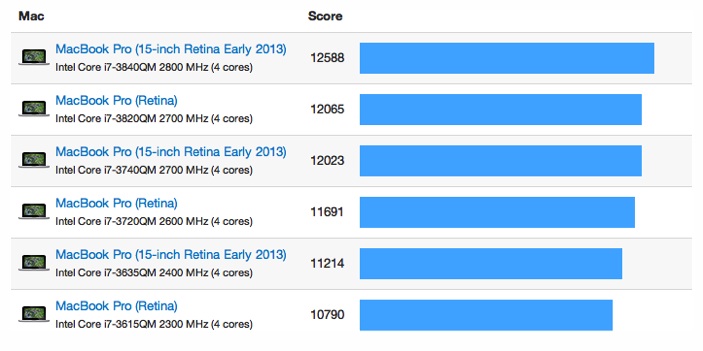
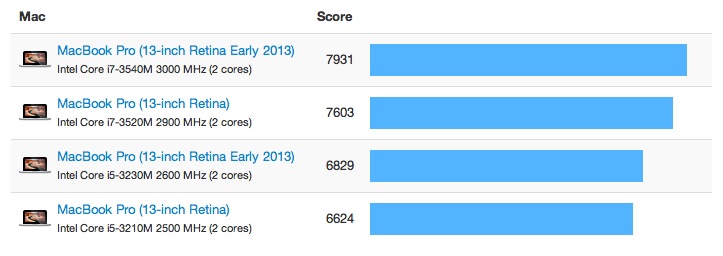
Following last week's introduction of new processors for the Retina MacBook Pro lineup, Primate Labs has analyzed benchmarks coming in from the new machines through the company's popular Geekbench 2 software. 

Unsurprisingly, the benchmarks reveal a roughly 3-5% increase in Geekbench scores for each of the processor bumps. For the 15-inch Retina MacBook Pro lineup, Apple bumped each of the three available processors by 100 MHz, accounting for the minor benchmark improvements. 


One thing to note is that the new mid-range Retina MacBook Pro has the same speed processor as the old high-end Retina MacBook Pro. However, the new mid-range model is slightly slower than the old high-end model. While this seems surprising at first, the difference is easily explained by comparing the two processors: the old high-end processor has more cache than the new mid-range processor.

For the 13-inch lineup, the 100 MHz speed bumps were limited to machines based on the high-end stock configuration starting at 256 GB of storage, with those machines also seeing a 3-5% improvement in Geekbench scores. 


Aside from the processor improvements for the Retina MacBook Pro lineup, Apple also reduced pricing on the 13-inch models by $200-$300, increased RAM on the high-end 15-inch stock configuration, and reduced pricing on storage options.

[Source: MacRumors]

Apple Seeds iOS 6.1.3 Beta 2 to Developers, Fixes Passcode Security Issue

Apple’s iOS 6.1.3 beta 2 is rolling out, and it reportedly fixes that awful security lock screen bug. According to 9to5Mac, the beta might also squash recent jailbreaks, though this has yet to be verified. Apple has been kicking out incremental updates over the last few weeks at a pretty high clip. Let’s hope that when iOS 6.1.3 is rolled out, something new doesn’t break along with it.

[Source: TechnoBuffalo]