Google Surfaces your Photos in Search

Looking for a picture you took at your sister's bridal shower? Google's search engine will now help you find it -- so long as you've posted the shot to the company's companion social network.

The company announced Thursday that Google+ members can log in to Google.com and search for their own photos or query for a buddy's pictures stored on the social network. Just plug in queries such as "my photos from Vegas" or "Angie's wedding photos" and Google will scour through Google+ photo albums and return matching images on the search results page...

Read the full story here. Source: CNET

Electronic Cigarette Technology

Electronic cigarettes have received a large amount of press recently with a number of studies researching the increased use of e-cigarettes in the UK. The BBC published an article at the beginning of the year predicting that e-cigarette use in the UK is set to reach 1 million users this year. But what exactly are electronic cigarettes and what is the technology behind these devices?

E-cigarettes are battery-powered devices which heat a water-based nicotine e-liquid until it becomes a vapour that can then be inhaled by users, this is known as vaping. The physical action of vaping is similar to smoking a traditional tobacco cigarette. E-cigarettes contain significantly less of the known harmful chemicals produced when burning tobacco. There are no second hand smoking dangers associated with them as they only release a water mist or vapour.

There are two types of e-cigarette products – disposable throw-away devices and rechargeable battery-operated models. E-cigarettes are made up of three major technical components: the battery, vapour device and refill capsule or e-liquid holder.

The batteries developed and used to power e-cigarettes are usually lithium ion batteries. Intellicig, a leading e-cigarette company based in Manchester are at the forefront of e-cigarette technology. They have designed a 10 second cut-off feature within their products. This additional feature means that if the battery is activated for longer than 10 seconds, the microprocessor will register that and automatically turn off the device to prevent it from overheating. Cleverly, it also allows a few more seconds for the device to fully cool down before it returns to normal standby mode. At one end of the device is a coloured LED light which illuminates when it is in use. The coloured light highlights that the device is an e-cigarette and not a traditional cigarette.

The vapour device is a consumable piece of technology designed for heating the e-liquid solution. An atomiser inside the vapour device heats the e-liquid solution until it becomes a vapour which can then be inhaled by the user. The vapour device is repeatedly heated and cooled during use and it is recommended that you purchase spare vapour device components if you are using a rechargeable model.

The refill capsule holds the e-liquid. In a rechargeable e-cigarette device these capsules can be replaced. E-liquid is available in a range of different nicotine strengths and flavours. The capsule part of the device also acts as the mouthpiece through which to inhale the e-liquid. Refillable models are a cost-effective vaping option. Once a capsule is empty, simply unscrew and discard, before replacing with a new capsule. The disposable refill capsules or cartridges are sometimes referred to as cartomisers and they connect to the battery and vapour device.

The majority of electronic cigarettes are designed and manufactured as three piece models. E-cigarette technology is constantly been improved and developed. It is a fast-paced and continually changing industry with new products and accessories been introduced all the time. It will be interesting to see what the next step is in the e-cig market and what products will be released, with companies investing a huge amount of money into developing new technology to offer users an enhanced vaping experience.

Apple to Expand Social Network Integration in iOS 7 with Support for Flickr and Vimeo

Apple has been making efforts to offer deep social network integration in its mobile operating system, first offering Twitter integration in iOS 5 and then Facebook integration in iOS 6. According to 9to5Mac, Apple will expand its social network integration even further with iOS 7, including support for both photo sharing site Flickr and video sharing site Vimeo

As with Facebook and Twitter integration, Vimeo and Flickr integration will allow users to be able to sign in to the social networks in the Settings menu. Those one-time sign-in credentials will be usable across iOS, providing comprehensive sharing options and easy integration with other downloaded apps.

Flickr is a logical addition to iOS given Apple's existing relationship with Yahoo, and popular video hosting site Vimeo is also a logical choice for iOS 7 as Apple continues to move away from Google products. Apple stopped offering YouTube as a stock iOS app with iOS 6 and also introduced its own mapping app, discontinuing its use of Google Maps. 

While Apple continues to allow direct video uploads to YouTube from its camera app, Vimeo integration will give iOS 7 users an additional option for video uploads. As with Yahoo, Apple has an existing relationship with Vimeo, having offered integration with the service in OS X Mountain Lion. 

As noted by 9to5Mac's unnamed source, though Flickr and Vimeo integration is currently in the works, as with all beta software, there is a risk that it could be removed before the public release of iOS 7. 

Apple's upcoming operating system is expected to feature a "flatter" design to modernize the look of iOS 7 while removing many of the skeuomorphic design elements that were introduced with iOS 6. Apple is expected to debut iOS 7 at its upcoming Worldwide Developers Conference in June with a release to follow in the fall, and MacRumors has noted a surge in traffic from devices running iOS 7 suggesting that a preview is imminent.

Source: Mac Rumours

Twitter fights hacking with two-factor authentication

After a string of high-profile hacking incidents, Twitter has finally introduced a two-factor authentication system as a way for members to keep their accounts more secure.

On Wednesday, the information network rolled out the new login verification feature, which people can select to require entry of a six-digit code, in addition to their standard password, to gain access to their Twitter accounts.

"When you sign in to twitter.com, there's a second check to make sure it's really you," the company said in a blog post announcing the optional security feature.

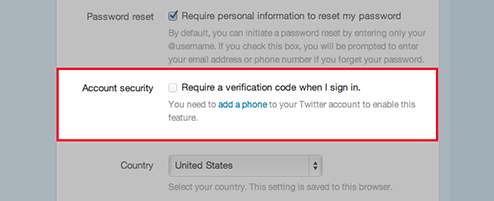
The two-factor system mirrors that of Facebook's and requires members to provide a phone number to which Twitter can send a unique code with each login attempt. Twitter users can turn on two-factor authentication from their Account Settings page, where they can tick the box to "Require a verification code when I sign in." Users then need to enter their phone number, and Twitter will subsequently text the number for verification purposes.

"With login verification enabled, your existing applications will continue to work without disruption," Twitter said. "If you need to sign in to your Twitter account on other devices or apps, visit your applications page to generate a temporary password to log in and authorize that application."

The additional security measure certainly complicates the login process, but the extra step is one many Twitter users, particularly brand users, will welcome with open arms. Last month, the Twitter accounts of CBS News' programs "60 Minutes" and "48 Hours" were compromised by hackers. (Disclosure: CNET is a unit of CBS Interactive.) The Associated Press was also the victim of a particularly cringeworthy breach when hackers sent out a false tweet that claimed the White House had been bombed. This news caused an immediate dive in the stock market.

Two-factor authentication should help Twitter defend against hacking attempts and partly repair its reputation as a public square for people, businesses, and celebrities.

Source: CNET

BOOM! NASA CAPTURES MASSIVE MOON EXPLOSION ON VIDEO

This NASA artist concept shows what the impact may have looked like.

It's a good thing you weren't standing on the moon's Mare Imbrium crater on March 17. You might have been ground into space dust. A meteoroid "the size of a small boulder" crashed into the lunar surface and exploded with a flash so bright, it was visible to the naked eye from Earth.

NASA has been keeping an eye on the moon for eight years, looking for explosions caused by meteoroids. The space agency has seen hundreds of detectable impacts, but none quite so spectacular as this one. "For about one second, the impact site was glowing like a fourth magnitude star," NASA says...

Read the full story here. Souce: CNET

YOUNG AND OLD: A SIDE-BY-SIDE LOOK AT TUMBLR, YAHOO AUDIENCES

Sometimes a picture really is worth a thousand words.

Yahoo has agreed to acquire 6-year-old blogging powerhouse Tumblr for $1.1 billion. The mammoth deal has sent the Internet into a tizzy, especially since most would have pegged the two companies as unlikely bedfellows just a week ago.

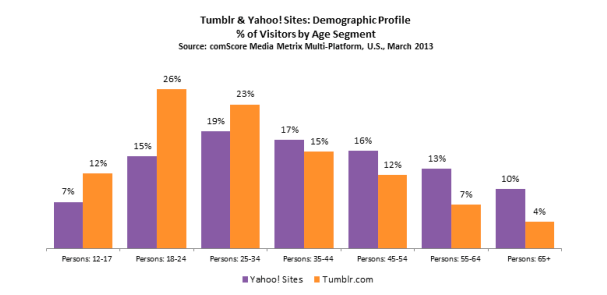
The simplest and most obvious reason for Yahoo's interest in Tumblr can be seen in the chart above, which highlights the dramatically differing demographic profiles for the media portal and the blogging network.

It's a tale of two audiences. Tumblr is a fountain of youth. Yahoo is practically a retirement community. Specially, a majority of people, or 61 percent, who visited Tumblr properties from Web or mobile in March are 34 or younger, according to analytics firm ComScore. Conversely, 56 percent of Yahoo visitors in March are over the age of 35.

With the $1.1 billion buy, Yahoo chief Marissa Mayer has purchased some much-needed insurance for Yahoo's future.

Source: CNET

Facebook's rocky year as a public company

Facebook's freshman year as a public company played out like an MTV drama in which Mark Zuckerberg was forced to navigate through an awkward accommodation with the rough-and-tumble world of Wall Street.

Even as Wall Street lectured loudly, a preoccupied Zuckerberg was only half listening and seemed more interested in saving the world from a dearth of sharing than worried about quarterly revenue performance. By year's end, though, Zuckerberg had earned his passing grade by demonstrating a masterful understanding of how to make money on mobile. Indeed, Facebook has seemingly weathered the worst even though it was an an uneven year with more than the usual fill of drama, one punctuated by extreme highs and lows...

Read the full story here. Source: CNET

Lamborghini Egoista concept looks like a space fighter

We've seen some pretty out-there limited-edition cars from luxury manufacturer Lamborghini, but its newest may have just taken the biscuit and sped off with it.

The Egoista, unveiled at the closing gala of the 50th anniversary Grande Giro tour, was designed by Volkswagen's head of design, Walter De Silva, and it's meant to be the ultimate in self-indulgence.

"This is a car made for one person only, to allow them to have fun and express their personality to the maximum," De Silva said. "It is designed purely for hyper-sophisticated people who want only the most extreme and special things in the world. It represents hedonism taken to the extreme, it is a car without compromises, in a word: egoista (selfish)"...

Read the full story here. Source: CNET

Apple Announces Winner of App Store's 50 Billionth Download Contest

Apple today announced the winner of its "50 Billion App Countdown" promotion that saw the company pass that milestone on Wednesday afternoon. 

Word game Say the Same Thing from the band OK Go was the milestone download, with Brandon Ashmore from Mentor, Ohio making the winning download. Ashmore will will receive an iTunes Gift Card worth US$10,000. For the first time, Apple also gave the fifty downloaders after the big winner US$500 iTunes Gift Cards.

Apple ran similar promotions for ten billion and twenty-five billion downloads, in January 2011 and March 2012 respectively. 

The App Store took just under five years to hit the fifty billion download mark, though the rate of downloads has been accelerating and is now at more than 20 billion app downloads per year.

Source: Mac Rumours


Apple to Relocate Flagship San Francisco Retail Store to Union Square

Apple's San Francisco flagship retail store has been a particularly high-profile location for the company since it opened nine years ago, but the San Francisco Chronicle reports that Apple has submitted plans to move the store to a new location three blocks away. The new location at Stockton and Post streets will be directly adjacent to Union Square, the focal point of San Francisco's high-end shopping district.

Apple says that the new location will increase its staff from the current 350 to 400 at the new location, but no timeline for construction and the move has been announced. 

The current flagship store at 1 Stockton Street is located directly adjacent to an entrance for a subway station serving both San Francisco's Muni Metro and the broader BART rail system. The new location is several blocks from the main Market Street transit corridor, but remains well served by transit and city officials hope that the new location will help draw more customers into the Union Square shopping district. San Francisco is also in the early stages of work on a new Central Subway line that will include a station directly at Union Square. 

Source: Mac Rumours


Google Unveils Google Play Game Services for Android, iOS and Web

At today's Google I/O keynote, Google unveiled Google Play Game Services, which is designed to compete with Apple's Game Center. Like Game Center, Game Services features real-time multiplayer capabilities, leaderboards, cloud saves, and achievements.

The service is not limited to Android developers as Google has developed it to link gaming across Android, iOS, and the web. Google will be providing the SDK for Game Services to both iOS and web developers in addition to Android developers. As noted by Engadget, Game Services more closely resembles the now-defunct OpenFeint social gaming platform than Game Center.

Google's Game Services comes several years after the introduction of Apple's Game Center. Game Center was originally introduced in 2010 and underwent a major overhaul in late 2011.

Source: Mac Rumours

Google launches All Access music-streaming service in the US: $9.99 monthly fee

And now, one of the most anticipated I/O announcements. As rumored, Google has been working toward the launch of its own music-streaming service, and the official unveiling came today. Dubbed Google Play Music All Access, the product has a strong focus on personalized recommendations via the so-called Explore feature. As with Spotify and other services, All Access will let you start a radio station while listening to a particular track, and in-depth tweaking controls allow you to nix songs that don't suit your fancy. Another feature demoed onstage is Listen Now, which highlights new releases and content Google thinks you'll enjoy.

As anticipated, All Access will require a monthly fee. A subscription costs $9.99 in the US, and all users will get a 30-day free trial. The service is launching stateside today, and if you sign up before June 30th, you'll get $2 off the monthly fee. We'll be taking All Access for a test drive as soon as possible -- check back for our initial impressions.

Source: Engadget