Samsung Running an iPhone 5 Attack Ad in Newspapers on Sunday

CNet and Businessinsider have published a new print ad that Samsung will be running in national newspapers tomorrow.
And so Samsung is greeting the arrival of the iPhone 5 with an ad that will run tomorrow in certain national and local newspapers (how modern). It is not a flattering ad. It suggests that the iPhone 5 isn't even good enough to be, well, a copy of the Galaxy S3.

The ad is titled "It doesn't take a genius." which serves as a dig against Apple Retail's genius bars. The rest of the ad shows the iPhone 5 alongside the Samsung Galaxy S III and lists a number of system specifications as well as features. The list is obviously heavily weighted towards Samsung where many of their software features are preferentially listed. At the end is the line "The Next Big Thing Is Already Here". 

Apple and Samsung have been competing head to head in the smartphone market and in the courtroom. Apple won a massive victory in their U.S. patent trial against Samsung with a $1.05 billion verdict. 

[Source: MacRumors]

Skype promising CD quality sound from new 'Opus' audio codec, fewer choppy calls

Skype's got a new audio codec that it thinks you should be pumped about, and it's called "Opus." It's been kicked around at Skype since March 2009, though work didn't begin in earnest until June of the same year, and it was just certified by the IETF as a standard of online audio. Senior Skype architect Koen Vos lead a team of audio engineers to create the hybrid audio codec, combining Skype's own "SILK" codec with Xiph.Org's "CELT" codec, intending to create a low-bandwidth codec "designed for the internet." But what does that mean for us? It means "CD quality" audio (fullband stereo sound) over Skype, regardless of internet connection. And what about those pesky packet loss issues that cause Skype calls to often sound choppy? "It has multiple mechanics to deal with and recover from packet loss plaguing the network," promises audio/video product engineering director Karlheinz Wurm. So ... uh, less of a chance of sounding like an Autobot then? Great!

[Source: Engadget]

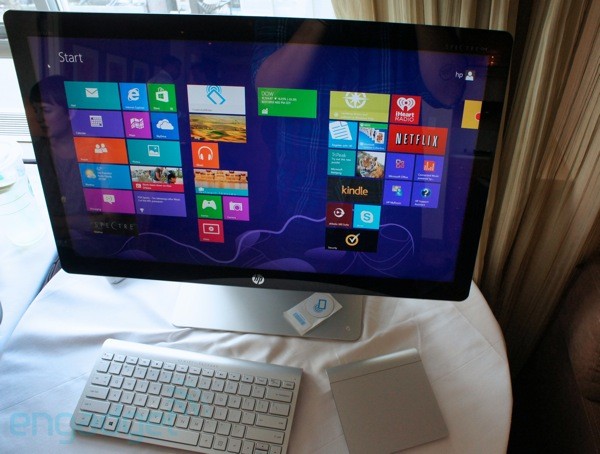
HP announces Spectre One desktop, three other all-in-ones

Didn't you hear? All of HP's top-shelf product consumer products will henceforth have the word "Spectre" in the name. So, it makes sense that the company would expand beyond laptops and release a futuristic desktop bearing the same branding. Indeed, the company just announced the Spectre One, a 23.6-inch all-in-one with a skinny design and nice-to-have features like NFC.

Though that aluminum frame and tilting 1080p display are pleasing to look at, the real story isn't what the Spectre One has, so much as what's missing. You see, in order to get the system down to 11.5mm thick, the design team had to forgo certain features you might otherwise expect -- features like a TV tuner, touchscreen and even an optical drive. It's a gamble, to be sure, but HP is betting that fashion-forward, tech-savvy users won't really mind. (The jury is out on whether a Windows 8 all-in-one without touch is a missed opportunity.) In any case, HP did include four USB ports (two of them 3.0), HDMI input, an Ethernet jack, Beats Audio and a memory card reader, with optional discrete graphics and SSDs. The components are also easily serviceable via a back door, if tinkering is your idea of fun. Lastly, the One ships with a keyboard, Magic Trackpad-style wireless touchpad and two NFC tags, which can be assigned to favorite websites.

[Source: Read more at Engadget]

Are apps organising your kid’s lives?

Apparently, whatever we need in life, there’s an app for it.  And with the meteoric rise of the android smartphone, portable tablet and light and compact notebook showing no sign of slowing down, this probably won’t come as much surprise to you.  

With the sheer volume of handy apps available, the majority of us are beginning to wonder how we ever survived without having a tool to regularly check the weather in the Outer Hebrides or track our daily bowl movements (yes, this is a real app) We’re using apps increasingly to organise both our business and social lives and reaping the benefits in both.

However, the demographic most reliant on electronic devices to organise their lives are students, who have turned to technology for every day tasks such as checking grades, ticking items off their things to do list and organising their homework schedule.  

Our kids have grown up using this ever-improving technology and are becoming increasingly reliant on apps to determine their every move.  Long gone are the days of having to stock up on dictionaries, calculators and note-books, new terms now are all about getting the right apps on the right device. 

Within an increasing number of schools, rather than being punished for having a phone at school, teachers are beginning to embrace the technology and alternative learning opportunities apps offer them.   Teachers are regularly using apps such as Socrative and Skitch to engage students with educational exercises and interactive activities that the whole class can share.   

Aside from the educational benefits, students are benefitting from apps such as Stylebook to organise their wardrobe and make outfit decisions based on the clothes they have available.

It’s not just the teens who are incorporating digital technology and apps into their everyday lives; schools, pre-schools and even nurseries are using apps to help them educate, inspire and organise children - playing interactive learning games to help children with their letter formation and word pronunciation, and flashcard apps to help with revision and study.  [Advertorial]

Premier Farnell, Sony, team up to move Raspberry PI manufacturing to the UK

One of the biggest holdups to owning a Raspberry Pi was its stuttering availability, so much so that it even prompted a few copycat boards. Creator Eben Upton and equipment makers Premier Farnell might have found the solution, teaming up with Sony to produce an initial run of 300,000 of the educational computers at the company's UK Technology Center, in Pencoed, near Bridgend in Wales. Upton hopes to keep the cost at $25 and $35 for two boards, thanks to employing Sony's "lean manufacturing techniques," and the Japanese company has already spent £50,000 ($80,000) on new package-on-package assembly equipment -- ensuring that we'll all be able to get our hands on one soon enough.

[Source: Engadget]

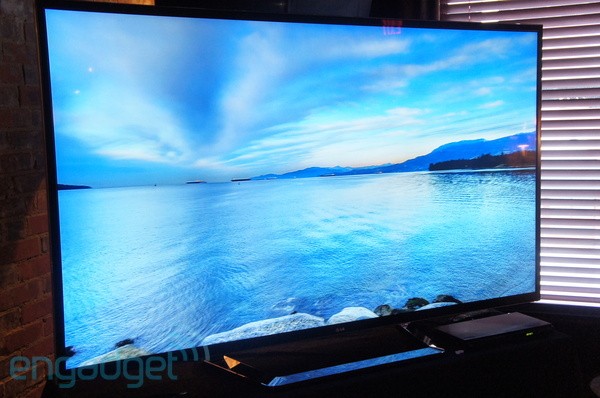
LG's 84-inch 4K ultra high definition TV goes on sale in the US next month for $19,999

LG said it would release its 84-inch 4K (3,840 x 2,160, or four times the resolution of your current HDTV) UHDTV outside Korea this month and the company confirmed shipments would be on the way during an event at CEDIA 2012 before also announcing an MSRP of $19,999. According to LG the first units will begin shipping this month, with limited availability through the usual high-end sources slated for October. Just as we'd heard, the 84LM9600 includes LG's passive glasses Cinema 3D technology plus all the Smart TV, WiDi, dual-core L9 processor, 2.2 channel speakers and Magic Remote bells and whistles it can muster.

Of course, even $20k currently doesn't buy a large selection of publicly available 4K content, although LG was displaying the unit with standard 1080p content to demonstrate its "Resolution Upscaler Plus" capabilities. The 1080p video we watched was sharp and clear on the big LED backlit set, although there was a bit of glare from the lights in the room -- not atypical for demo setups that aren't exactly like most living rooms. In just a few weeks well-heeled consumers will be able to choose between this and the slightly pricier Sony 84-inch 4K TV, with more competition on the way soon. Also an option: a decently equipped 2013 Ford Focus. Check the press release after the break for all the details, we'll be checking Mark Cuban's couch cushions for spare change.

[Source: Engadget]

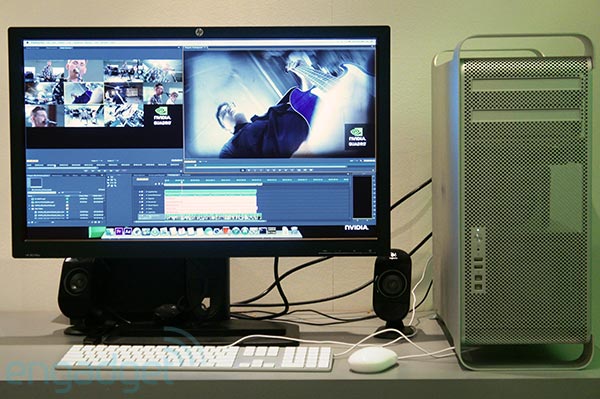
NVIDIA Quadro K5000 GPU for Mac offers significant Premiere Pro performance boost

NVIDIA just announced that its new Quadro K5000 GPU will be available on Mac Pros, offering 4K display compatibility and support for up to four displays, not to mention 4GB of graphics memory and about 2x faster performance than the Fermi-based Quadro 4000. While the Kepler-powered chip won't actually hit Apple systems till later this year, we got a first look at the K500 on a Mac here at IBC. NVIDIA demoed Adobe After Effects and Premiere Pro CS6 on a Mac Pro with dual K5000 GPUs.

As you'll see in the video below, with 11 streams of 1080p video at 30 fps in Premiere Pro (and one overlay of the NVIDIA logo), GPU acceleration handles the workload seamlessly, letting us add effects in real time without any processing delay. Switching to software rendering mode in the editing program shows a night-and-day difference: video playback is extremely choppy, and processing moves at a crawl. Even with two K5000 chips in this desktop, Premiere Pro utilizes just one, but After Effects takes advantage of both GPUs. In this program, NVIDIA showed us ray-tracing, a computationally intensive 3D imaging feature, which only became available in After Effects with the release of CS6. Like in Premiere Pro, the program runs smoothly enough to let us edit images in real time. Take a look for yourself by heading past the break.

[Source: Engadget]

Nokia invites you to stay tuned, offers augmented reality teaser

With just a day to go, Nokia has pushed out another brief teaser, this time pointing towards more map-based contextual functionality. It looks like whatever the company's got up its sleeves, alongside any new Lumia hardware, should include some map-based social network chops and City Lens features -- not much of a shocker given that the latter has just shed its beta status.

Update: Nokia's throw out another video -- which reveals that its good-looking star does manage to find those shoes. Phew. We've added it after the break.

[Source: Engadget]

Popcorn Hour launches A-400 streamer for €289 with 'studio-quality' 3D video processing

If you're a streamer who shuns plastic disks and their ilk, but still wants 3D, there's good news: Syabas has announced the Popcorn Hour A-400 network media player. Thanks to a dual-core video processor, the box can mulch through 3D Blu-ray content (ripped, presumably), while also supporting studio-level features like detail enhancement and debanding. Like its A-300 predecessor, the streamer can dock a hard disk for content storage, and connects to your network via ethernet or optional WiFi. Other connections include an SD card reader, HDMI 1.4, eSATA and USB 2.0 and USB 3.0 (pending confirmation). On top of giving you access to your own content, the Syabas Apps Market brings YouTube, BBC's iPlayer, and 90 or so other free or premium channels. It'll hit stores in October with a €289 price tag, so if that sounds like your bag of popcorn, see the PR for more info.

[Source: Engadget]

Freesat launches its smart new TV guide called

Freesat, the UK’s free-to-air digital satellite television provider, today launches a new smart on-screen TV guide, available in its next generation Freesat+ boxes.

Called <free time> the service offers new features in a single, simple and easy to use guide:

  • A backwards TV guide letting you turn back time and watch programmes that have already been on, but you may have missed
  • An ‘at a glance’ Now & Next view to show what’s on the minute you sit down
  • A new Showcase section that offers recommendations on programmes to watch tonight, in the coming week and on demand
  • On Demand TV from BBC iPlayer and ITV Player with 4OD and Demand 5 launching before Christmas
  • Improved recordings that make it even easier to record TV at a touch of a button and find episodes automatically filed into series – just like a DVD boxset


The next generation Freesat+ boxes join the existing range of Freesat digital satellite HD boxes and integrated HDTVs and will be available to buy from John Lewis, Currys, Comet and other retailers and online later this month. Set top box manufacturer Humax is producing the first new box with <free time> and will be priced at £279. Boxes from Sagemcom, Philips and Manhattan will follow.

Connecting the box to home broadband will power the backward TV guide, give access to On Demand and the full Showcase. Freesat is also planning to launch additional movie and music services in the future.

Developed using widely adopted European open standards for hybrid TV including elements of OIPF, HbbTV and HTML 5 browser technology, <free time> will offer additional services and features in the future, including a companion app for smartphones and tablets to create remote control and remote record capability away from the traditional remote.

Emma Scott, Managing Director of Freesat said: “TV is a simple pleasure that technology can make even better, not more complicated. Our new boxes with <free time> give satellite viewers everything they get with freesat today and so much more in a single, simple and easy to use on screen guide. We want to help viewers find something great to watch the minute they sit down, so they can spend less time searching and more time watching the TV they love.”

“Having now exceeded 2.6m Freesat sales we’re thrilled to be launching <free time> today and offer satellite homes more quality, choice and value without a subscription.”  [Advertorial]

Japanese judge rules Samsung didn't infringe on Apple music/video sync patent

A Japanese judge has ruled that Samsung did not violate an Apple patent on "synchronizing music and video data in devices to servers," Bloomberg reported this morning.  While that victory is sure to be heralded by most (if not all) who are reading this story on this site, it's important to remember that this case is separate from the one Samsung recently split in Korea, as well as the $1.049 billion verdict against it in U.S. federal court a week ago.  This synchronization lawsuit was initiated by Apple in Japan, and claimed that the Samsung Galaxy S, Galaxy SII (S2) and Galaxy Tab infringed on its patent, noted above. Apple was seeking 100 million yen ($1,273,400 USD) in the case, which eventually ruled in favor of Samsung, who did not have to pay any damages.

The damages seem quite low in comparison to what Apple was just awarded in its U.S. lawsuit victory, but it should be noted that only 5.7 percent of Apple's sales came from Japan last quarter, which is far less than the sales numbers each company posts in the U.S. market. Regardless of the size of the possible damages, it's still a victory for Samsung over a rival's patent holdings.  We hope, but seriously doubt, that this'll be the last we hear about Samsung and Apple fighting in the courts.

[Source: Android Central]

Students – Get the Latest Tech and Stay Within Budget

It’s an exciting time for all students at the moment. Whether you’ve just received you’re ‘A’ Level results and are preparing for the big move to University or even if you’re a returning student heading back for the second or third year, the excitement levels are building ahead of the reunion with friends or the meeting with new ones and experiencing student life.


One unfortunate part of the student lifestyle is of course budgeting, with money always hard to keep hold of. You want to show that you can survive on your own, without having to run to the bank of mum and dad every few weeks to borrow a few pounds for a night out or a food shop, (there’s only so many tins of own-brand beans you can survive on!) Associated with the budgeting issues is of course the concern of making an impression on your new flat mates and course mates. You want to show them that you’ve got the latest gadgets, the best trainers and the designer clothes. So how do you combine the two? It’s nearly impossible.


Evaluating the market is a great place to start. While it looks great to show off your brand new device from the biggest name out there, it doesn’t look so good in the bank account. A lot of manufacturers of smartphones, tablet computers, laptops and even colour laser printer models have realized that there is a gap in the market and are targeting those customers. This gap has been identified as the people priced out of buying the big name brand models, and the majority of these more cost-effective and customer-friendly devices feature the same, if not similar, specifications as the product that is twice as expensive. This means not only do you save substantial amounts of money, but you get just as good a product, only with a different badge on it.


If you set yourself a budget before walking into the electrical store, and think about what you actually want your product to do and help with, it is much simpler to shop. If you know you want your computer, for example, to help with word documents, have a built-in webcam and microphone and help you with your graphic design course, then the one with the best spec for those requirements should be top of your agenda, not looking for the one with the best software package providing you spend over a certain amount. 


Checking online auction sites is another great way of getting the latest tech without having to pay full price. Students just like you might have gotten into financial difficulties and need some quick money, so they decide to sell off items that are worth decent money, or even items that they don’t need any more because they’ve either finished their course of a specific module. By checking here you could get some real bargains – and you’re not a proper student until you get into the habit of hinting for a bargain!


If you can find a way of remaining within budget, you’ll be in a very healthy position at the end of your academic year. You’d be able to go on more night’s out at the end of the semester and even be in a position to either clear some of your overdraft, put money towards the next year of your course, or survive the summer without having to look for seasonal work, allowing you to relax ahead of the new term.