Virgin Media begins pushing its UK broadband to 120Mbps, much to Usain's delight

If you're one of Virgin Media's top-tier internet customers, you may soon see your service getting a little speedier. The Branson-backed company is boosting its top speed from 100Mbps to 120Mbps, thanks to a £110 million ($169 million) infrastructure investment. The majority of the network -- around 60 percent -- has yet to be supercharged, but you can use the coverage checker linked below to see if you're in-line for an early Christmas present from Sir Richard.

[Source: Engadget]

BBC launches iPlayer Radio: a separate radio-only mobile app and web UI

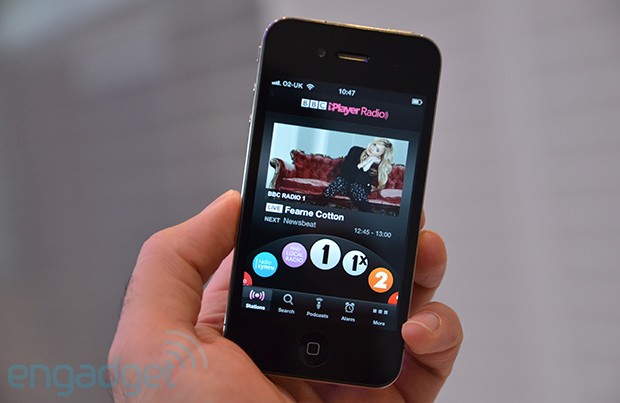
No one can accuse the BBC of neglecting radio in its quest for streaming nirvana -- not when the number of radio listeners on iPlayer has shot up 56 percent in a year (and 300 percent on tablets). Nevertheless, from tomorrow morning, iPhone users will find a brand new way to listen to their favorite content: a dedicated radio app with a spinning dial which -- compared to the regular iPlayer app -- will put much greater emphasis on live shows rather than catch-up. There'll also be mobile-friendly features like an alarm clock which will wake you up to your choice of show, reminders for shows you just can't miss, and the ability to identify current and recently-played songs at a glance. The app will reach Android too, as soon as some Flash-related difficulties have been ironed out, and its alarm function will benefit from slightly better multi-tasking on Google's OS, so you won't have to leave the app open before you fall asleep. If you don't want to wait or if you're outside the UK, check out the desktop iPlayer at the source link, or the gallery below, and you'll see just what the Corporation's philosophy about treating radio differently -- rather than as "TV minus video" -- actually looks like.

[Source: Engadget]

Larklife fitness tracker syncs your data over Bluetooth, knows when you're running instead of walking

In case you haven't noticed, fitness gadgets are having something of a moment right now. The past year alone has seen the launch of Nike's FuelBand, the ill-fated Jawbone Up and a refreshed line of Fitbit trackers. Now another product is arriving that promises to do basically the same thing -- namely, track your activity, sleep patterns and food intake using a wearable gadget and mobile app. That thing you see up there is called Larklife and for now, at least, it works exclusively with iOS devices. It's a splash-resistant (but not waterproof) band that has a pedometer inside, counting your steps throughout the day. It can also tell how long you sleep each night, as well as how long it takes you to nod off. There's even a vibrating alarm built into the band -- something we first saw on the Up earlier this year. (As it happens, Lark's earlier products were sleep aids, so the inclusion of this feature actually makes a lot of sense.) As for monitoring your dietary habits, Larklife doesn't automatically track your food intake, but the app does include a food diary where you can manually enter your meals.

Additionally, Larklife uses Bluetooth Smart to automatically sync with your iPhone so that you don't have to plug the band into a PC just to update your fitness stats. (The new Fitbit trackers work this way this too.) Additionally, the band uses a proprietary technology that can discern when you're running or walking, which means the app will log workouts even if you forget to enter them. The last intriguing bit is that the app dishes out smart, contextually aware advice. Didn't get much sleep last night? Larklife will remind you to eat more protein than usual at breakfast, so that you have enough energy to get you through the day. The app also rewards good behavior in the form of iOS notifications and colorful on-screen badges, though competing products admittedly take a very similar approach when it comes to keeping users motivated.

Larklife is up for pre-order starting today, and is priced at $150 -- a rather large premium over the new Fitbit One, which will sell for $100. As for precise availability, all we know is that retailers will start stocking Larklife "before the holidays." Whether that means Halloween, Thanksgiving or some gift-giving celebration will be revealed some other day.

[Source: Engadget]

Amazon Cloud Drive update adds easy iPhoto album uploads for Mac users

Amazon issued a press release today to announce that its Cloud Drive service is rolling out in Italy and Spain after hitting the United Kingdom, France, and Germany earlier this month. An easier way of uploading iPhoto albums for Mac users is also included in the updated Cloud Drive app release. Clicking the Cloud Drive menu bar item will allow you to select “Import from iPhoto,” and now you can select from multiple iPhoto albums sorted by events before uploading to Cloud Drive.

[Source: 9to5Mac - Read more there]

Street View comes to Google Maps web app on iOS, just like they said it would

While the hubbub surrounding Apple Maps on iOS 6 has been somewhat sedated, some people who made the move to Google Maps' web app had been further encouraged by word that it'd be getting Street View imagery soon. And what do you know, barely seven days into the estimated "in two weeks" and here it is. Search for a location (no long press yet), and you'll spy the familiar icon bottom right. This appears in both Chrome and Safari. While perhaps still not quite as slick as the good old app of yore, a definite panacea for all those iOS toutin' virtual tourists.

[Source: Engadget]

Microsoft buys PhoneFactor, adds smartphone authentication to its cloud services

With a hand-in-glove relationship with the world of business, it's key that Microsoft ensures it can keep companies data safe. That's what prompted Steve Ballmer to whip out his checkbook to snap up PhoneFactor, a multi-factor authentication company that uses smartphones instead of code-generating security tokens. With its new toy, Redmond plans to integrate the feature into its services like SharePoint, Azure and Office 365, letting users sign on with their own device as a key element of the signing in process.

[Source: Engadget]

Zuckerberg: more than one billion people using Facebook actively each month

Active accounts have become one of the hottest currencies online, especially for social networks. Previous boasts by Facebook have been quickly shot down, but this latest number is pretty hard to ignore. According to Zuckerberg himself the site now has 1 billion active monthly users. That's right, one in seven people on the planet logs on to the social network at least once a full moon cycle. The announcement comes via the site's official news blog, which if the numbers are true, could mean most of you have read this already.

[Source: Engadget]

Evernote web interface updated with better sharing, cleaner look

We're huge fans of Evernote here at the Engadget compound (it's great for keeping track of our latest world domination schemes). But, we've got to admit, the web service is clearly the company's red-headed step child. The desktop and mobile apps are undeniably top-notch, but the webapp is just sort of there. Being able to edit your notes and share them from any browser is a great feature, but we wouldn't exactly call it an enjoyable experience. Today the company took the wraps off a revamp that should ease the pain a bit. Evernote is particularly proud of its new shared note design, that offers a much more attractive and interactive look at entries. You can reshare notes, enter a slideshow view or copy it to your own account. The broader redesign is subtle, but refreshing. There are new icons, some color changes and a tweaked top bar that lend a less cluttered feel without removing functionality. There's even a handy button that collapses the sidebar for those of you rocking smaller laptop screens. We also noticed that the new interface seems to load notes with multiple images much faster. You can read about it straight from the horses mouth at the source or just go to the Evernote homepage and check it out yourself.

[Source: Engadget]

Gmail now searches attachment text, homework hoarders rejoice!

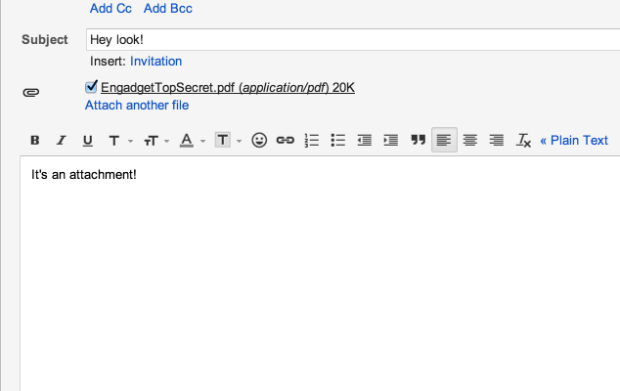
As Google continues to improve other areas of its broad ecosystem, it's always great to see that the company hasn't abandoned its search simplification roots. A spokesperson for the company told us, "we recently added the ability to search within Gmail attachments as part of our ongoing efforts to improve search." This potential time-saver plays nice with Word docs, PDFs, PPTs and many other file extensions. Currently in its infancy, some of your older attachments may not have been indexed yet, so you might not be able to "share" last year's term paper with your younger sibling until Google brings the feature up to speed. However, if you're just looking to locate that recently received Word doc filled with notes from your study buddy, then have at it.

[Source: Engadget]

Fujitsu eye-tracking tech uses built-in motion sensor, infrared LED for hands-free computing

Eye-tracking technology looks to be one of the major tropes at CEATEC this year. One of many companies demoing a gaze-following setup is Fujitsu, which is showing off a prototype desktop PC with a built-in sensor and infrared LED. This configuration should be cheaper than many other eye-controlled solutions out there, as the components are integrated directly into the computer and no external hardware is needed. It's sweet and simple: the camera captures the reflection of light on the user's eye, and image processing technology then calculates the user's viewing angle to allow for hands-free navigation on-screen.

[Source: Engadget - Read more there]

Sony reveals Japan prices for Windows 8 devices, adds touchscreen to VAIO L, E14P and T13

With Windows 8 finally launching in less than four weeks, it's only a matter of time before the web is flooded with prices of upcoming PCs, the first among which this month hail from Sony VAIO's Japan branch. Starting with the Duo 11 slider PC, it's expected to go for about ¥150,000 ($1,930) when it launches in Japan on October 26th (alongside Windows 8), and it'll come with a 1080p display, 1.7GHz Core i5-3317U, 128GB SSD, 4GB RAM and WiMAX. Then we have three flavors of the Tap 20 portable all-in-one which will range from about ¥140,000 ($1,800) up to about ¥180,000 ($2,310) come November 3rd, with the main differences being the CPU (1.8GHz Core i3-3217U, 1.7GHz Core i5-3317U or 1.9GHz Core i7-3517U) and the RAM (4GB or 8GB), but all three will feature the same 20-inch 1,600 x 900 display and 1TB hard drive.

Also announced at the Tokyo event are Japan prices for three more existing VAIO models that now feature a touchscreen: ¥130,000 ($1,670) for the T Series 13 Ultrabook with Core i5-3317U, ¥150,000 ($1,920) for the VAIO E Series 14P laptop with Core i5-3210M, and from ¥210,000 ($2,700) to ¥240,000 ($3,080) for the VAIO L Series 24-inch all-in-one with Core i7-3630QM and 1080p display. The two laptops will be available in Japan from October 26th, whereas the all-in-one will join in from November 3rd.

There's no indication as to whether the US prices will match their Japanese counterparts (the former are usually a lot cheaper), but hey, stay tuned here and you'll know as soon as we do.

[Source: Engadget]

Nominet proposes more secure .UK domain for British websites


Nominet is considering a .uk internet domain for users who can't bear to type the extra three characters necessary for .co.uk. The body is lobbying for the new domain in time for ICANN's next TLD expansion, which includes new entries like .shop, .play and .home. Nominet has promised tough entry requirements for the system, with only businesses (or persons) that can prove a UK presence being eligible to register. It'll also be around four times more expensive, with the extra charges going to pay for daily malware scanning to prevent domain spoofing and a donation to a trust to improve web security. If you're an interested party, you can offer your tuppence-worth at the body's official public consultation which runs until January 7th 2013.

[Source: Engadget]